
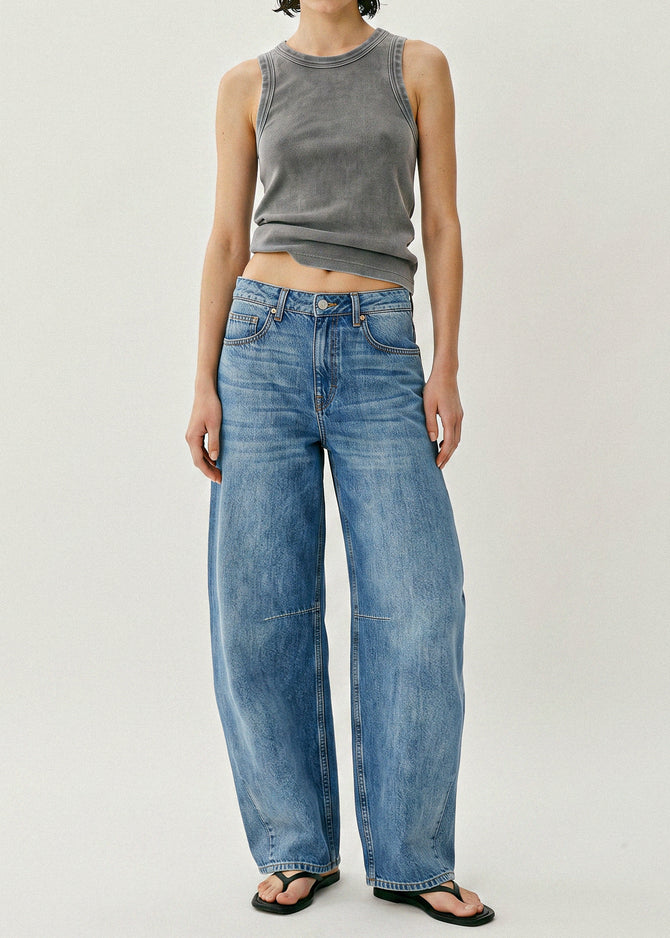


The small metal rivets on jeans help reinforce places that take repeated strain, especially the corners of pocket openings. They work alongside the stitching; they are not the buttons you undo to get dressed. Rivets can also contribute to a jean’s appearance, but their number, color or visibility alone does not tell you how durable the whole garment will be.
Small hardware with a specific job
A pocket opening is a place where fabric is repeatedly pulled as you reach inside or carry something. Rivets provide additional fastening at selected points, working with the sewn construction rather than replacing it.
That practical role has a long history. Levi Strauss & Co. records that Jacob Davis and the company’s riveted-workwear innovation was patented on May 20, 1873, with reinforcement at pocket openings and seams central to the idea. The brand’s history of riveted denim explains that origin.
On a contemporary pair, look at where the hardware sits, not just whether it is shiny. A small metal piece at a pocket edge and the larger fastening at the waist have different jobs.
Rivet, button or bar tack?
A rivet stays in place
A pocket rivet fastens fabric at a particular point. It is not intended to be opened and closed during dressing. Small round hardware near the front pocket corners is the familiar example.
A button operates a closure
The waistband button passes through a buttonhole to close the jeans. A button fly has additional buttons along the opening. Size and shine can help you spot them, but function is the useful distinction: closures open; pocket rivets reinforce.
A bar tack is made from thread
A bar tack is a compact group of closely placed stitches used to reinforce a stress point. Lee’s denim anatomy guide describes this technique around areas such as pockets and belt loops. A short stitched mark is not metal hardware, and not every visible row of topstitching is a bar tack.

Why some pockets have no visible metal
Exposed rivets are not the only way to approach reinforcement. Some designs use stitches at pocket corners; others may conceal hardware. An exterior photograph cannot settle every detail of the construction.
One well-documented example is the Levi’s 501 back pocket. After exposed rivets scratched furniture and saddles, the company covered them in 1937. In 1966, it replaced those back-pocket rivets with bar tack stitching. That is the specific history described in The 80-Year Coverup, not a rule for every jean made today.
The useful takeaway is simple: an absence of visible metal does not mean an absence of reinforcement. If a particular construction matters to you, ask the brand instead of inferring it from a distant product photo.
Look closely without pulling anything apart
For a pair you own, a calm visual check is enough to identify the different parts. You do not need to test them by tugging hard on the pocket.
- Find the location. Separate pocket-edge hardware from the waistband closure.
- Look at the surrounding fabric. Notice an obvious tear, an opening around the attachment or a piece that has come loose.
- Notice comfort. If hardware catches clothing or feels rough against you, avoid rubbing or forcing it.
- Ask before attempting a repair. Send the retailer or a denim repair specialist a clear photo and the location of the concern. Do not pry out, hammer or glue the piece as an experiment.
This check describes what you can observe; it does not establish how much force a rivet can withstand. For a broader buying assessment, see our guide to evaluating denim quality.

A closer look at Miley in Charleston
NOEND’s Miley Straight in Charleston offers a clear example of these visible distinctions. Its product photographs show small copper-tone rivets at the front pocket edges and coin pocket, alongside a larger silver-tone waistband button. The back patch pockets show topstitching without exposed metal visible in those views.
Miley is listed as 100% cotton, made in the USA, with French outseams. Those are product details, not a laboratory rating. “Copper-tone” describes the hardware’s appearance here; it does not establish its alloy, coating or hidden structure.
A few common questions
Are rivets only decorative?
No. Their familiar role is reinforcement, although their finish and placement also become part of a jean’s appearance. Do not assume every decorative metal detail has the same function.
Do more rivets mean stronger jeans?
A rivet count is not a durability result. It tells you neither how securely the hardware was attached nor how the rest of the garment performs.
Are all copper-colored rivets made from copper?
Color alone cannot establish metal composition. Use the manufacturer’s specification if that information matters to your purchase; do not guess from a photograph.
Is the metal piece at the waist also a rivet?
The visible piece you pass through the waistband buttonhole is a closure button. Even if its attachment looks similar to other hardware, its role differs from a fixed pocket rivet.
Once you know where to look, these small details become easier to read. Explore the front and back views of Miley Straight in Charleston to see how the pocket hardware, waistband button and stitching sit within one everyday jean.