
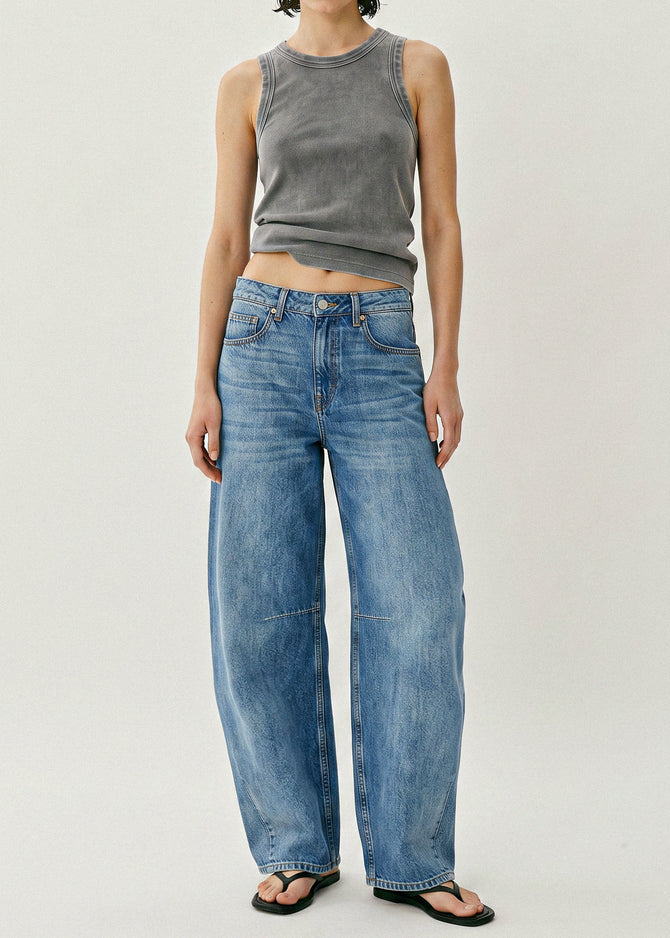


Rigid denim uses structure to hold a silhouette; stretch denim adds measured flexibility for movement and a closer fit.
Buy rigid denim if you want a more structured silhouette, visible character from wear, and do not mind a firmer first feel. Choose stretch denim if immediate mobility and a closer fit matter more. Neither is universally better: check the fiber content, the cut, the recovery, and the garment measurements before deciding.
The useful question is not whether rigid or stretch denim is “better.” It is which fabric behavior supports the shape you want and the way you actually move. A relaxed curved jean and a close-fitting flare ask different things of denim, so the right answer can change from one silhouette to the next.
What “Rigid” and “Stretch” Actually Mean
Rigid denim
In everyday shopping language, rigid denim usually means denim made without an added elastic fiber. A 100% cotton label is the clearest common example. The fabric can still bend, soften, and relax through wear; “rigid” does not mean immovable. It means the cloth does not rely on elastane to spring back.
That distinction matters because structure is part of the design. Rigid denim can make a curved leg, wide leg, or straight leg read more clearly. Seams and darts remain visible, and the fabric tends to create broad folds rather than cling to every contour.
Stretch denim
Stretch denim commonly blends cotton with a small amount of elastane, spandex, or Lycra. In traditional cotton-stretch construction, an elastic core can be wrapped with cotton fibers; CottonWorks describes this core-spun approach as one way denim gains stretch across the fabric.
Fiber percentage is helpful, but it is not the whole experience. Weave, yarn, fabric weight, finishing, pattern shape, and the quality of recovery all affect how a jean feels. Even 100% cotton can be engineered for some mechanical give, so read the composition label as a starting point—not a complete performance test.

The Five Differences That Matter When You Wear Them
1. The first five minutes
Rigid jeans usually feel more definite at first. You notice the waistband, rise, and seat immediately, which makes correct sizing important. Stretch denim often gives more readily when you sit, climb stairs, or bend, but it still should not pinch, pull sharply at the fly, or force the pockets open.
2. The silhouette
Rigid denim is especially effective when shape comes from the garment itself: a barrel curve, a wide leg, a sculpted dart, or a crisp straight line. Stretch denim is useful when the pattern is meant to stay closer through the hip and thigh while allowing movement. Neither fabric dictates one fit, but each supports certain proportions differently.
3. Break-in versus immediate ease
Cotton fibers and the weave can relax with body heat and motion, so rigid jeans may feel less firm after several wears. That relaxation is not the same as elastic stretch, and it is not a reason to buy a painfully tight size. Stretch denim usually offers ease from the first wear; the tradeoff is that its all-day feel depends on recovery as much as stretch.
4. Recovery and bagging
Recovery means how well fabric returns after it has been extended. More stretch does not automatically mean better recovery. A well-engineered stretch denim can move and return cleanly; another may relax noticeably at the knee or seat. With rigid denim, some creasing and personalized wear are expected parts of the look rather than a performance failure.
5. Care
Follow the garment care label for either type. Cool washing and avoiding unnecessary high heat are sensible defaults, especially for stretch denim, because excessive heat can be hard on elastic components. Wash when the jeans are actually dirty or have lost their shape rather than after every brief wear.
Which Denim Should You Buy?
Choose rigid denim when the shape is the point
Rigid denim is a strong choice if you want a sculptural leg, a substantial hand, and a jean that records wear through folds and fading. It also works well when the pattern already provides room through the hip and thigh. You are choosing the fabric’s body as much as its fiber content.
Choose stretch denim when movement is built into the fit
Stretch denim makes sense when you prefer a closer line through the seat and upper leg, commute in jeans, sit for long periods, or want more immediate flexibility. Look for a secure waistband and fabric that returns after you bend the knee. The jean should move with you without looking poured on.
If you are unsure, start with the silhouette
Choose the leg shape and rise you want first, then decide how much structure or give helps that design. A roomy rigid jean may feel easier than a very slim stretch jean; a stretch flare may feel more natural than a rigid flare cut too narrowly at the knee. Fit, fabric, and pattern have to be read together.
 Compare standing shape, seated movement, and the fabric in your hands before deciding.
Two NOEND Examples: Same Category, Different Jobs
Kallie Relaxed Curve in Baltimore: rigid structure
The Kallie Relaxed Curve in Baltimore is 100% cotton. Its 13-inch rise, loose hip, wide curved leg, inner-knee darts, and tapered hem darts use rigid denim to hold a distinct architectural line. Because the cut supplies room, the absence of elastane does not require the jean to feel narrow or restrictive.
Donna 90’s Mid Rise Flare in Everwood: stretch with structure
The Donna 90’s Mid Rise Flare in Everwood is 99% cotton and 1% Lycra. Its 10-inch rise, closer upper leg, side-panel detail, 33-inch inseam, and 21-inch leg opening make controlled flexibility useful: the jean can move through the fitted area while retaining the long flare line.
These examples are not a universal rule that curved jeans must be rigid or flares must stretch. They show how fabric choice can reinforce a specific pattern. That relationship is what you should look for when comparing any two pairs.
A Two-Minute Fitting-Room Test
For rigid denim
Stand, sit, and take a high step. The waistband should feel secure without pain; the fly should lie flat; the pockets should not pull open; and you should be able to sit without holding your breath. Expect firmness, not distress. Check that the leg shape falls as intended rather than collapsing because the size is too large.
For stretch denim
Bend each knee, sit for a minute, then stand and look again. The fabric should return smoothly at the knee and seat. If the waistband already gaps, the thigh ripples heavily, or the denim feels loose before you have moved, sizing down is not always the answer—the pattern may simply be wrong for you.
Frequently Asked Questions
Does rigid denim stretch over time?
It can relax and mold through wear, especially at high-motion areas, but it does not behave like denim with an elastic fiber. Some of that relaxation may reset after laundering.
Is 1% Lycra enough to feel different?
It can be. The effect depends on how the yarn and fabric are engineered, not only on the percentage printed on the label. Try the jean in motion and judge its recovery.
Should rigid jeans be tight when new?
They may feel firm, but they should not be painful or prevent normal sitting and walking. Do not depend on break-in to correct a clearly wrong rise, waistband, or hip fit.
Which type is more flattering?
The one whose rise, proportions, and fabric behavior create the line you want. Rigid denim can define an intentional silhouette; stretch denim can follow a closer cut. “Flattering” comes from the whole jean, not a single fiber.
The Bottom Line
Choose rigid for structure, character, and a garment-led silhouette. Choose stretch for immediate mobility and a fit that sits closer to the body. Then verify the choice by moving in the jeans and reading the fiber label—because the best denim is the one whose fabric and pattern are solving the same problem.
To see the contrast in real proportions, compare the structured Kallie Relaxed Curve with the flexible Donna 90’s Mid Rise Flare. The difference is less about choosing a side than choosing the behavior you want from your next pair.