


Jeans can twist at the leg when the fabric shifts toward its preferred alignment, moving the seams around the leg rather than straight down it. Twill construction and finishing can play a role, especially as the fabric relaxes through care. A curved seam in one photograph is not enough to diagnose a fault: first check the garment’s design, fit and care history.
Follow the seam, not just the crease
Leg twist describes rotation along the trouser leg: a seam that starts at the side may travel toward the front or back farther down. It is different from a horizontal crease behind the knee or extra fabric gathering over a shoe. Start by finding the actual stitching, then follow its path.
Also compare the pair with its original product photos. Some jeans use curved panels, shaped seams or an intentionally asymmetric design. A seam that is not perfectly vertical is not automatically a change caused by washing.
Check the whole leg in a relaxed position
A bent knee, turned foot or angled photograph can make the leg look different. Stand naturally with both feet comfortably on the floor and the waistband where you normally wear it. Look from the front and side without pulling the denim into position. The question is whether the garment consistently rotates, not whether every line looks ruler-straight.
Why denim can turn after it becomes a pair of jeans
Denim commonly has a diagonal twill structure. That direction can influence how the fabric settles, carrying a sewn leg around with it. Iron Heart’s denim glossary describes leg twist in both right-hand and left-hand twills and explains pre-skewing as a way to address it before a garment is made.
Pre-skewing is a manufacturing treatment, not a direction to twist wet jeans by hand. CottonWorks’ skewing guidance notes that the amount needs to be assessed for the fabric: too little or too much can affect the result. Washing and drying can make remaining skew more apparent.
The fiber label does not tell the whole story
“100% cotton” does not identify the weave direction or finishing process. CottonWorks also explains that yarn twist affects fabric skew, alongside other characteristics. You cannot determine whether a finished pair will rotate from its fiber content, price or color alone.

A useful check takes more than one mirror angle
If the rotation bothers you, a short record is more useful than repeatedly tugging the seam back. For a new purchase, keep the tags attached and follow the return conditions while you decide whether to keep it. Do not wash or alter an uncertain pair just to investigate.
- Compare the design. Check the listing’s front, side and back views for the intended seam placement.
- Look at both legs. Photograph the jeans in a natural standing position, including the waistband and hems.
- Take them off and lay them down. Smooth the fabric gently without stretching or forcing the seams to meet. Notice how the legs rest on their own.
- Record when you noticed it. Was it present at the first try-on, after wearing, or after washing? Note the care method and whether the change affects movement or comfort.
These observations help you explain the issue; they are not a laboratory test or a universal pass/fail standard. If you are concerned about a pronounced or uncomfortable change, send the retailer clear photos and the care history rather than guessing at the cause.

Be cautious about a quick untwisting fix
A seam can be pulled into place for a moment without resolving why the leg turns. Do not assume that reverse-twisting, a hot soak or forceful pressing will permanently correct the fabric. Follow the garment’s care label instead of adding heat or tension as an experiment.
A denim-aware tailor can assess a specific pair, but a simple hem adjustment is not the same as correcting a rotated leg. If you were already planning to shorten it, raise the seam issue first. Our guide to what to check before hemming jeans covers the separate alteration decision.
Use a clear silhouette as your comparison point
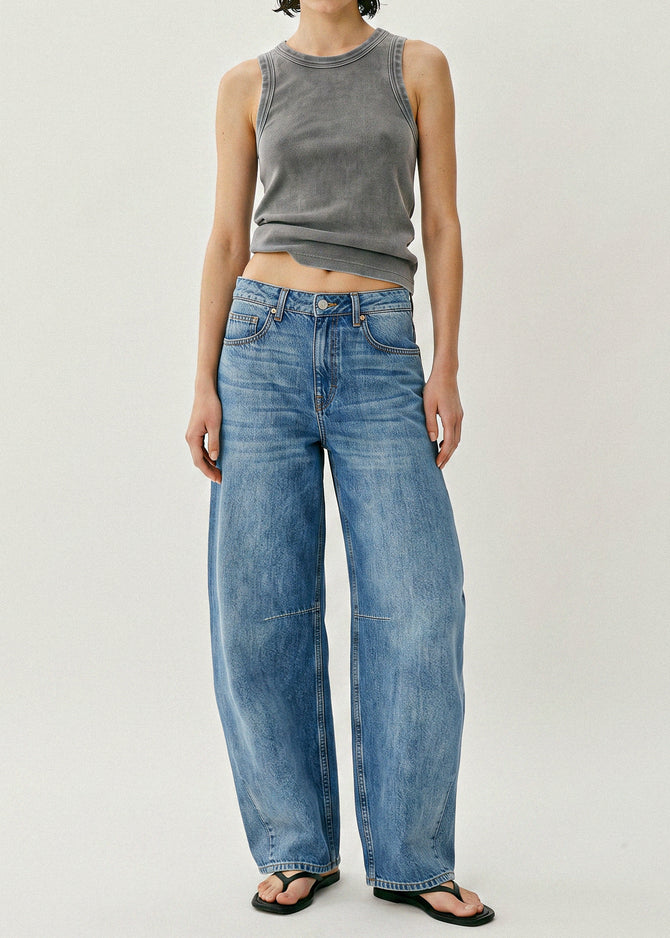
NOEND’s River High Rise Wide Straight in Helena provides a useful visual reference for checking a full leg line. The current product is a high-rise, five-pocket wide-straight style in 100% cotton. Compare the photographed seam placement and overall silhouette with how your own pair sits.
Those details describe the design—not a promise that the fabric is twist-proof. The product information does not establish a specific pre-skew treatment or a leg-twist test result. When comparing jeans, keep verified construction details separate from performance assumptions.
Questions worth asking
Is leg twist always a manufacturing defect?
No single visual clue settles that. Twill behavior, finishing and the intended design can all matter. Ask the retailer to assess the specific pair if the rotation is unexpected, pronounced or uncomfortable.
Can washing make a seam turn?
Washing and drying can reveal changes in the fabric’s alignment. That does not prove that you washed it incorrectly. Compare what happened with the garment’s care instructions and share that information with the seller.
Does sizing up stop jeans from twisting?
Not reliably. Another size changes the fit, but it does not establish a different weave or finishing treatment. Choose a comfortable size and assess the seam concern separately.
Will hemming straighten the leg?
Shortening changes the bottom edge, not necessarily the alignment of the remaining leg. Have a tailor inspect the rotation before cutting, especially if you still have return or exchange options.
The next step is a clearer comparison, not a stronger tug. If a high-rise wide-straight silhouette is what you want, review River in Helena from the front and back, then use its measurements and your own comfortable try-on to judge the fit.