

A useful size-chart comparison starts with a flat, unstretched waistband and the same measuring method used by the brand.
To read a jeans size chart correctly, first identify whether it lists body measurements or finished-garment measurements. Then measure yourself—or a pair of jeans that already fits—using the same method and units. Compare waist, hip, rise, and inseam instead of relying only on the size number. Finally, account for fabric composition and the fit the style is designed to create.
First, find out what the chart is measuring
This is the step that prevents most sizing mistakes. A chart labeled with waist and hip measurements may describe the person the garment is intended to fit, or it may describe the physical jeans themselves. Those numbers are not interchangeable because a garment can be smaller, equal to, or larger than a body measurement depending on stretch, rise, construction, and intended ease.
Body-measurement chart
A body chart usually asks for the circumference of your natural waist and the fullest part of your hips. The brand has already allowed for the intended fit of the jean. If your body measurements fall into different columns, do not average them automatically; read the style notes and consider which area is least adaptable in that particular cut.
Finished-garment chart
A garment chart gives the dimensions of the actual jeans, often measured flat. It may list a flat waist, hip, front rise, back rise, thigh, knee, leg opening, and inseam. Compare these numbers with a similar pair that fits you—not directly with your body—unless the brand explains otherwise.
Size label only
A number such as 27, 28, or 29 is a label within that brand and style. It is not a promise that the finished waistband has exactly that circumference, and the same labeled size can fit differently across rises, fabrics, washes, and silhouettes. Treat the number as the final selection after comparing measurements—not as the measurement itself.
How to take your body measurements
Natural waist
Stand normally and wrap a soft measuring tape around the narrowest part of your torso, usually above the navel. Keep the tape level and comfortably snug without pulling it into the body. Do not assume this number is the same as the waistband placement of low-, mid-, or high-rise jeans.
Full hip
Measure around the fullest part of the hips and seat with feet together. Check in a mirror that the tape is parallel to the floor. This measurement is especially useful for rigid jeans, fitted seats, and styles where the hip area has less room to adapt than the waistband.
Inseam preference
For the most practical comparison, measure the inseam of jeans that already have the length you like. Begin at the crotch seam and follow the inside leg to the finished hem. Shoe height and the intended silhouette matter: a full-length curved or wide jean may need a different inseam from a cropped straight jean.
How to measure jeans you already own
Choose a pair with a similar rise and silhouette to the jeans you are considering. Fasten it, lay it on a flat surface, smooth the fabric without stretching, and use the brand’s stated method whenever one is provided. Even small changes in tape position can create a misleading comparison.

Flat waist
Align the front and back of the waistband and measure straight across from one inside edge to the other. If the chart reports full circumference, double the flat measurement. Only do this when the brand confirms that its chart uses circumference; some charts already provide the flat width.
Hip
Measure straight across the jeans at the point specified by the brand, often a set distance below the waistband. There is no universal vertical position, which is why copying a measurement method from another retailer can produce the wrong comparison.
Front and back rise
The front rise runs from the crotch seam to the top of the front waistband. The back rise follows the same path at the back. Rise affects where the waistband sits, how the jean relates to your torso, and how much room is available through the seat. Compare rise numbers only when they were taken in the same way.
Thigh, knee, and leg opening
These measurements describe the shape below the hip. The thigh is commonly measured across one leg near the crotch, while the knee is taken at a specified point farther down. The leg opening is measured across the finished hem. Confirm whether the chart lists flat width or circumference before comparing.
Inseam
Measure from the crotch seam along the inside leg to the bottom of the finished hem. Do not substitute the garment’s total side length: the rise is included in the outseam, so the two measurements answer different questions.

How fabric and fit change the meaning of the numbers
Rigid 100% cotton denim
Rigid denim does not contain stretch fiber, so the initial garment dimensions and intended ease deserve close attention. Cotton can relax with wear in high-movement areas, but that is not a reason to choose a size that prevents comfortable sitting, creates severe pulling, or does not fasten naturally.
Stretch denim
A stretch blend may be designed with less ease because the fabric can recover and move. The percentage of stretch fiber alone does not tell you exactly how the jean will fit; fabric weight, weave, pattern, and wash also matter. Use the product-specific chart and notes rather than transferring a size from a different fabric.
Relaxed, straight, curved, and fitted cuts
A relaxed leg can have substantially more thigh and knee room than a straight or slim cut while using the same waistband size. A curved leg may be intentionally wide through the thigh and taper through darting. Read the silhouette description alongside the numbers so you do not mistake designed volume for an oversized fit.
What to do when you fall between sizes
Do not automatically size up or down. Identify where the measurements split. If the waistband matches one size but the hip matches another, consider the fabric, rise, and where the style is intended to be close or relaxed. Compare both sizes with a well-fitting pair and review the product’s fit note.
- For rigid denim: prioritize being able to fasten, sit, and move without severe strain; do not depend on dramatic stretching.
- For a deliberately relaxed style: check the waist and hip first, then confirm that the extra leg volume matches the design.
- For two plausible sizes: compare garment measurements, not only body measurements, and decide whether you prefer a closer or easier result.
- For centimeters and inches: use one unit throughout. One inch equals 2.54 centimeters; avoid rounding repeatedly across several measurements.
A NOEND example: reading Kallie Relaxed Curve in Baltimore
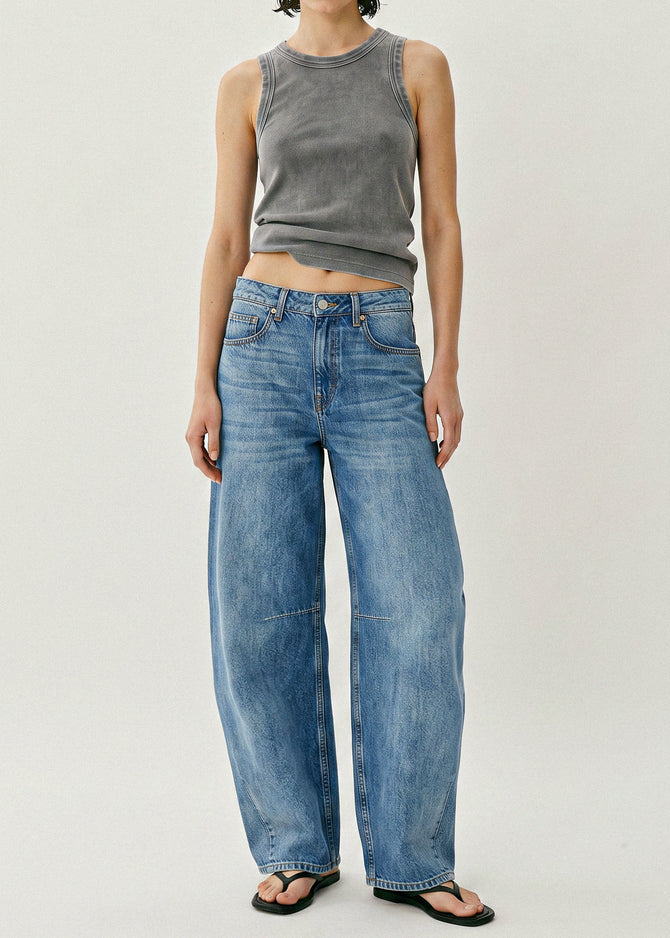
The Kallie Relaxed Curve in Baltimore is a rigid 100% cotton jean with a high rise, loose fit around the hips, and a full-length curved leg. The product page lists approximately a 13-inch front rise, 23.5-inch knee, 17-inch leg opening, and 31-inch inseam, and describes the fit as true to size. Those measurements explain the intended shape; they do not replace checking the waistband and hip against your own measurements or a comparable pair.
The knee and leg-opening numbers also show why a size chart should be read as a group. Kallie’s darts at the inner knee and hem create an inward curved line, so its leg measurements are part of the design—not simply an indication that the size is large or small.
Jeans size-chart questions, answered
Does size 28 mean a 28-inch finished waist?
Not necessarily. It may be a nominal size label, a body-waist reference, or a brand-specific designation. Check whether the chart lists body or garment measurements.
Should I double a flat waist measurement?
Double it only when you need an approximate full circumference and the chart uses that format. If the brand already lists flat width, doubling it would create the wrong comparison.
Which measurement matters most?
There is no universal winner. Waist and hip usually establish whether the top block can work, while rise and inseam determine placement and length. Thigh, knee, and opening explain the leg shape.
Can I use measurements from leggings?
They are a poor comparison for rigid jeans because stretch leggings are patterned and worn differently. Use jeans with similar fabric, rise, and silhouette whenever possible.
The simplest reliable sizing routine
Confirm the chart type, choose one unit, take body measurements, then measure a comparable pair flat. Read waist, hip, rise, and inseam together; add thigh, knee, and leg opening when silhouette matters. Finally, check the fabric composition and fit description. This takes a few extra minutes, but it gives you a much stronger starting point than choosing by the number on the label alone.
To practice the method on a clearly defined rigid-denim silhouette, review the listed measurements and fit notes for the Kallie Relaxed Curve in Baltimore before selecting your size.