
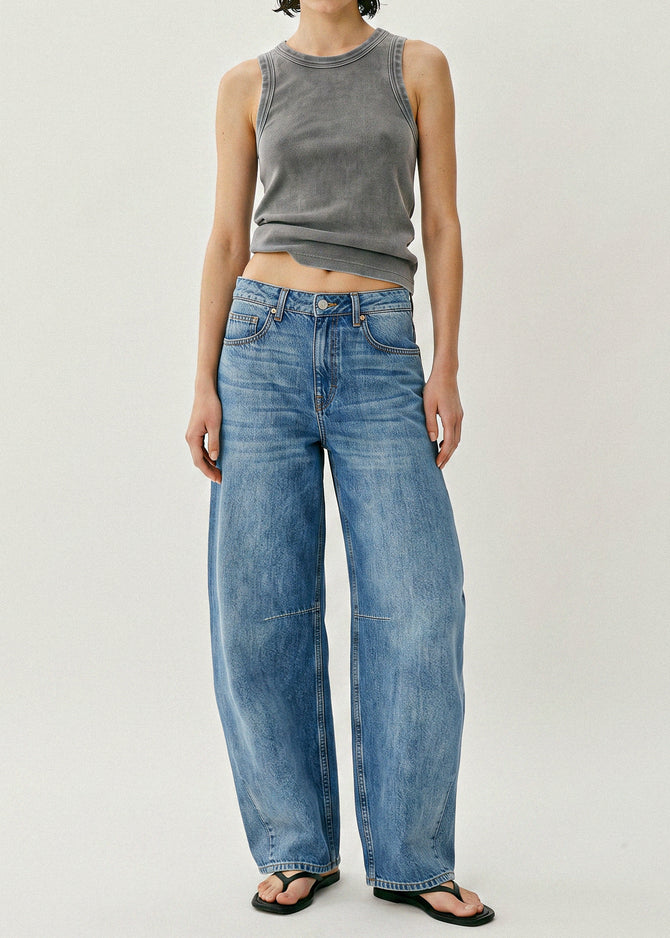


Jeans can bag at the knees when repeated bending stretches the fabric and it does not fully return to its earlier shape. But a fold behind the knee is not the same as a lasting bulge in front. Check when the change appears, how the jeans fit while you sit, and whether the shape remains after rest and label-approved care.
A crease is not automatically a bagged knee
A pair can look smooth while you stand and fold as soon as you sit. That is part of wearing a woven garment over a moving joint. The useful distinction is between fabric folding around your position and fabric continuing to project outward after you straighten your leg.
Ordinary movement folds
Look behind the knee and across the front while seated. Folds that change as you move, without leaving a persistent rounded pouch when standing, are not enough to diagnose a problem. A relaxed straight leg will also carry more loose fabric than a close-fitting cut.
A shape that stays after movement
Notice a rounded area that remains in front when your leg is straight? That is worth checking over time. Compare the same jeans before and after normal wear, in the same position. A single photograph, a bent knee or a shadow cannot establish permanent fabric growth.
Why the knee is a pressure point
Sitting, climbing stairs and bending repeatedly load the cloth over the knee. How much shape remains depends on more than the motion itself. Research on denim bagging has found that fabric characteristics and finishing conditions influence the result; it does not establish one universal outcome for every cotton or stretch jean. See the AATCC Journal of Research study on denim bagging.
The fit matters to your experience, too. If sitting makes the thigh and knee feel pulled tight, the cut may not offer the movement room you want. If the legs are loose from the first try-on, folds may be part of the silhouette rather than something that developed through wear.
Stretch and recovery answer different questions
Stretch describes how far fabric extends. Recovery describes how it returns after that extension; growth describes the change left behind under specified conditions. ASTM D3107 treats these as separate properties of stretch woven fabrics. A fiber-content label is not a recovery-test result.
That is why “more stretch” is not a reliable promise of “no knee bags.” Yarn construction matters: a study of single- and dual-core denim yarns found different elasticity and recovery behavior across constructions. You cannot rank two finished jeans simply by comparing their elastane percentages.

Try this before changing sizes
Use a normal fitting-room movement check, not an exaggerated stretch test. If you are trying a new purchase at home, keep the tags attached and follow its return conditions. Do not wash it just to see whether an uncertain fit improves.
- Start standing. Let the waistband sit where you intend to wear it. Look at the thigh, front knee and lower leg without pulling the fabric smooth.
- Sit normally. Place your feet on the floor. Notice pressure at the thigh and knee, a pulling waistband, or an urge to hike the legs upward.
- Stand and walk. Look again after moving. Do the folds shift with your position, or does a distinct pouch remain?
- Compare an owned pair over time. Photograph it in the same light and stance before wear, after wear and after a rest. This is a practical observation, not a standardized fabric test.
If the waist fits but the thigh feels restrictive, try a different leg cut rather than automatically sizing up or down. A smaller size may add tension; a larger one may introduce excess fabric elsewhere. Our guide to how straight-leg jeans should fit helps separate intentional room from an uncomfortable fit.
What to do when the shape bothers you
For jeans you already own, let them rest without stretching the knee area over a chair edge. When washing is needed, use the garment’s care label as the starting point. Recheck only when the jeans are fully dry. Some changes may be temporary; care is not a guaranteed way to reverse persistent deformation.
Avoid using a hot dryer, boiling water or a very hot iron as a targeted knee fix. Those methods can affect more than the area you want to change, and the correct treatment depends on the fabric and finish. If a pronounced change appears unusually quickly, photograph it and ask the retailer about that specific pair before experimenting.
Also look at where excess length gathers. Fabric stacking over a shoe can create folds farther up the lower leg. That calls for a length assessment, not an assumption that the knee fabric has failed. For that distinction, see our guide to intentional pooling at the hem.
Two NOEND fits to compare thoughtfully
Selma Loose Straight in Philadelphia is listed as 100% cotton, with a mid rise, a relaxed fit through the hips and thighs, and a straight leg. It is a relevant starting point if you want room through the leg rather than a close-fitting shape. That construction is not a claim that its knees never crease or relax.
Carla Mid Rise Ankle Mini Boot Jeans in Oklahoma takes a different approach: a slim hip and thigh, a gentle ankle flare, and 99% cotton with 1% Lycra. Compare its movement feel with the more relaxed Selma rather than treating the fiber percentage as proof of superior recovery. NOEND does not list a knee-bagging test result on either product page.
A few questions that come up
Does knee bagging mean I bought the wrong size?
Not necessarily. Persistent shape change, excess room from the start and ordinary bending creases are different situations. Check comfort and movement through the whole leg before changing size.
Can 100% cotton jeans show knee bags?
Yes, they can develop shape changes with wear. The label alone does not tell you how noticeable those changes will be. The fabric construction, garment fit and way the pair is worn all deserve attention.
Will washing remove the bulge permanently?
Do not count on it. Label-approved washing may change how the fabric sits, but it is not a guarantee against the shape returning during wear or a repair for damaged fabric.
Can a tailor take in just the knee?
A tailor can assess whether excess fabric is an alteration issue, but narrowing the leg does not improve the fabric’s recovery. It can also reduce bending room. Explain when the change appears before agreeing to a cut.
The useful next step is to choose the movement and silhouette you actually enjoy. Compare the roomier Selma in Philadelphia with the slimmer Carla in Oklahoma, then use the measurements and a normal sitting check to guide your choice.