
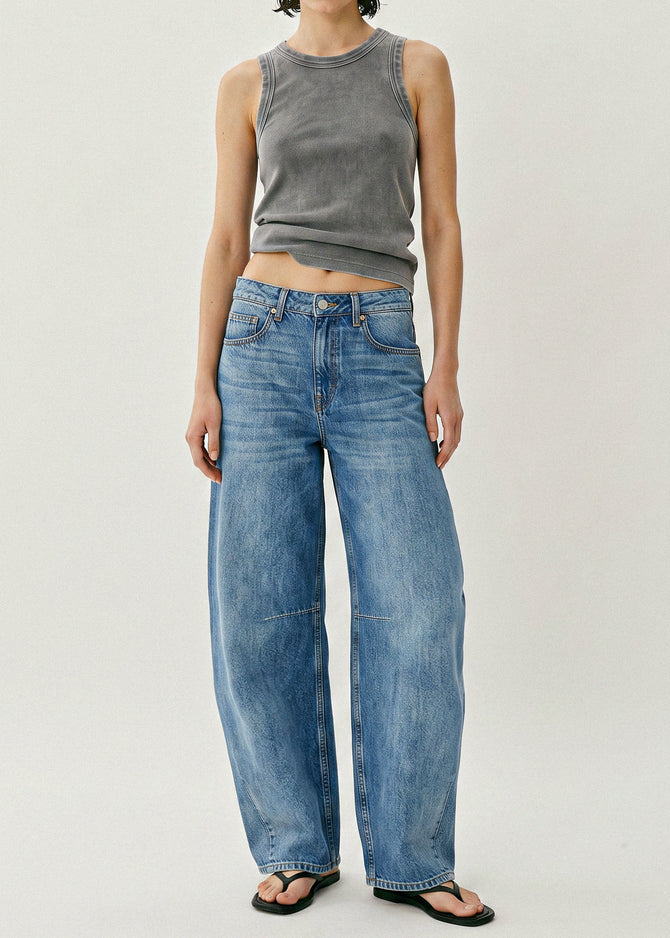


Straight-leg jeans should sit securely at the waist, follow the hips and thighs without pulling, then fall in a consistent line from around the knee to the hem. They do not have to be perfectly ruler-straight: some pairs taper slightly. The right fit leaves enough room to sit and walk comfortably, with a hem length that works cleanly with your shoes instead of bunching or dragging.
 A successful straight fit reads as one continuous line: secure at the waist, easy through the leg, and clean at the hem.
What should a straight-leg silhouette actually look like?
The name describes the overall visual line, not an identical measurement from hip to ankle. A classic straight jean usually follows the body through the upper block and becomes more consistent from the knee down. A slim straight may narrow slightly, while a relaxed straight can carry more room through the thigh and lower leg. Both can still read as straight when the lower leg does not cling like a skinny jean or widen into a bootcut or flare.
Judge the complete silhouette from the front, side, and back. The most useful question is not “Is every section the same width?” but “Does the leg fall cleanly without strain, collapse, or an unexpected change in shape?”
How should straight-leg jeans fit from waist to hem?
At the waist
The waistband should stay in place when you walk and sit without digging in. A small amount of ease is normal, but the waist should not slide downward, fold over, or require a belt just to remain secure. Check the rise at the same time: a waistband that feels tight may actually be sitting at the wrong place on your torso rather than indicating that the entire jean is too small.
Through the seat and hips
The fabric should follow your shape without horizontal stress lines radiating from the fly or pulling across the pockets. The back rise should remain close to the body when you stand, but it should still allow you to sit without the waistband being pulled sharply downward. Pocket edges should lie reasonably flat rather than being stretched open.
Through the thigh
A straight jean can skim the thigh or feel more relaxed, depending on the intended cut. Either way, you should be able to take a full step and sit naturally. Deep horizontal creases at the upper thigh, a fly that bows, or pockets that flare can signal that you need more room. Excess fabric collapsing into large folds may mean the cut is too relaxed for the line you want.
From the knee to the opening
This is where the silhouette becomes easiest to identify. The leg should continue downward without gripping the calf or kicking outward at the ankle. A modest taper can still be straight; the distinction is that it remains visually calm. Look for side seams that hang vertically and hems that sit at a similar height on both legs.
 Check the front and back together: the waistband stays level, the pockets remain flat, and the leg keeps a controlled path to the hem.
How much room should straight-leg jeans have?
There is no single correct amount because “straight” describes a family of cuts. A slim straight sits closer through the thigh and calf. A classic straight leaves moderate ease. A relaxed straight increases the room while keeping the lower leg from becoming dramatically wider. Choose the version that creates the line you want without compromising movement.
Use a movement test instead of relying only on the mirror. Sit in a chair, climb one step, bend your knee, and place a hand inside the waistband. Normal tension is expected, especially in rigid denim, but sharp pressure, restricted movement, or a waistband that shifts substantially are useful signs to reconsider the size or cut.
Where should the hem of straight-leg jeans fall?
The best hem depends on the intended length and the shoes you wear most often. Cropped straight jeans commonly finish above the ankle bone or around the narrowest part of the ankle, creating a deliberate gap above the shoe. An ankle-length pair can meet the top of a low shoe. A full-length straight jean may lightly touch the vamp, but it should not collect into heavy stacks unless that is an intentional styling choice.
Try the jeans with the actual shoes in your wardrobe before altering them. Pointed flats keep a cropped line polished; a slim ankle boot works when the shaft fits neatly beneath the opening; a low-profile sneaker gives the hem a casual finish. If your main goal is creating a longer visual line rather than solving fit, the companion guide on which jeans make your legs look longer covers rise, hem, and footwear as a separate styling decision.
 The cropped straight hem sits cleanly over sleek black ankle boots, creating a polished line with no extra bunching.
What are the clearest signs that the fit is wrong?
- The waistband pinches or slides: the size, rise, or waist shape may not suit your proportions.
- The fly bows or forms strong horizontal lines: the hip or upper-thigh area may need more room.
- The lower leg catches on the calf: the cut is behaving more like a slim or tapered jean on your body.
- The side seams twist: first smooth the jean into place; persistent twisting can reflect construction, laundering, or a fit mismatch.
- The hem pools heavily: the inseam is too long for the intended clean straight line or for the shoes being worn.
A NOEND straight-leg example
Claude High Rise Crop Straight in Highland
The Claude High Rise Crop Straight in Highland is a useful example of a clean cropped straight. The product page lists an approximate 10¾-inch rise, 26½-inch inseam, 15½-inch knee, and 14-inch leg opening. It is made from 100% cotton, is listed as true to size, and has a finished cropped hem. Those proportions create a controlled lower line rather than a wide or flared opening.
Measurements describe the jean, not how it will fit every body. Compare the listed rise and inseam with a pair you already own, then use the waist-to-hem checks above. If you prefer a longer and easier version of the silhouette, the Kent Relaxed Straight Jeans in Michigan are listed with a 10-inch rise, 31-inch inseam, 14½-inch knee, and 15¾-inch leg opening. That difference illustrates why “straight” can look either cropped and controlled or longer and more relaxed.
Frequently asked questions
Should straight-leg jeans be tight on the thighs?
They can skim the thighs, but they should not restrict walking or sitting. Strong pulling at the fly, pockets, or upper thigh suggests that a larger size or a straighter, more relaxed cut may work better.
Are straight-leg jeans supposed to taper?
A slight taper is common, particularly in slim-straight and cropped styles. The jean should still look consistent below the knee rather than clinging to the calf like a skinny jean.
Should straight-leg jeans touch the shoes?
They can, but they do not have to. Cropped pairs usually finish above the shoe, while full-length pairs may touch the vamp with little or no break. The hem should look deliberate and remain clear of the floor.
Should you size up in 100% cotton straight-leg jeans?
Not automatically. Start with the product’s size guidance and garment measurements, then evaluate movement and pressure points. Rigid cotton can relax with wear, but a painfully tight waistband or restricted hip and thigh area is not a reliable fit strategy.
The most useful next step is simple: try your preferred straight silhouette with the shoes you actually wear, check it from every angle, and move in it. For a cropped high-rise reference, explore the Claude in Highland; for a longer, easier line, compare the Kent in Michigan.