


Most jeans do not need washing after every wear. For ordinary, low-sweat use, roughly every 3 to 10 wears is a practical range—but condition matters more than counting. Wash sooner after heavy perspiration, visible dirt, spills, or persistent odor. Between washes, air the jeans and treat small marks promptly. Always let the sewn-in care label override general advice.
Why there is no single correct number
Two people can wear the same jeans for the same number of days and need completely different care. A short day in an air-conditioned office is not equivalent to a warm commute, a restaurant shift, travel, or hours spent outdoors. Fabric composition, how closely the jeans sit against the body, climate, activity, and where they were worn all affect the decision.
Published guidance also varies. The American Cleaning Institute gives about three wears as a general reference, while a denim manufacturer’s care guidance extends the interval to approximately ten wears. That difference is useful: the number is a starting point, not a hygiene law. Your jeans’ condition and care label are the better final authority.
The four-signal test: wash now or wear again?
1. Is there visible dirt or a spill?
Mud, food, oil, makeup, and sugary drinks should not be ignored just to preserve a wash count. Treat a fresh mark promptly according to the care label and the stain type. Blot instead of aggressively rubbing, and test any treatment on an inconspicuous area first. A tiny localized mark may need only spot treatment; a large spill or residue usually calls for a full wash.
2. Was there substantial sweat?
Wash sooner after high heat, a long active day, or noticeable perspiration. Pay attention to the waistband, upper thigh, pocket bags, and areas that sit close to the skin. Jeans worn briefly in cool, low-activity conditions can often be aired and returned to the wardrobe.
3. Does the odor remain after airing?
Hang the jeans in a dry, ventilated place for several hours. If a noticeable odor remains, it is time to wash. Spraying fragrance over odor does not clean the fabric, and putting jeans in a freezer is not a substitute for laundering.
4. Where were they worn?
A crowded commute, smoky venue, dusty workspace, contact with public floors, or food preparation can shorten the interval. A quiet desk day may lengthen it. Context is often more informative than whether the jeans have been worn exactly three, five, or ten times.

What to do between washes
After wearing, empty the pockets, smooth the fabric, and hang the jeans in a ventilated place rather than folding them immediately into a closed drawer. Let any moisture fully dissipate. Avoid hanging wet or damp denim in direct, intense sunlight if preserving the wash is the priority.
For a small mark, use the mildest method appropriate for the stain and garment label. Work from the outside of the mark inward, using a clean cloth and minimal moisture. Do not scrub the surface until it becomes visibly lighter; friction can alter an indigo finish even when the stain disappears.
How to wash jeans when it is time
Read the care label first
Denim is a construction, not one universal fabric. A rigid 100% cotton jean, a stretch blend, coated denim, embellished denim, and raw or unsanforized denim may require different handling. Follow the instructions sewn into the specific garment, especially when they conflict with general advice.
Prepare the garment
Empty every pocket, close the zipper and buttons, and turn the jeans inside out. Washing with similar dark colors can reduce the consequence of dye transfer. New dark denim may release color, so extra separation is sensible during early washes.
Use a restrained cycle
When the care label allows machine washing, cold water, a gentle cycle, and a modest amount of mild detergent are a conservative starting point. Avoid overloading the drum: the jeans need room for water and detergent to move through the fabric and rinse away. More detergent is not automatically cleaner and may leave residue if it is not fully rinsed.
Air-dry when the label permits
Reshape the waistband and legs after washing, then hang from the waistband or lay flat in a shaded, ventilated area. High dryer heat can be harder on fit, finish, and cotton fibers than air-drying. If the care label directs machine drying, use the specified setting rather than improvising.

Do different kinds of denim need different schedules?
Rigid 100% cotton denim
Rigid denim often develops personal creases and surface character through wear. Washing changes the feel and can shift the appearance over time, but avoiding washing indefinitely is not necessary. Use the four-signal test, then follow the label. Do not buy an intentionally uncomfortable size in the hope that wear or washing will correct it.
Stretch denim
Stretch fibers can respond differently to heat and repeated wear. A wash may help the jean return closer to its intended shape, but high heat can be unhelpful for elastic fibers. Again, the fiber content and care label matter more than a generic denim rule.
Black, dark, and heavily dyed denim
Dark color can show gradual fading and may transfer dye when new. Turn the garment inside out, separate it from light colors, and follow the label’s water-temperature and drying directions. Fading is part of how many jeans evolve, but gentler handling can make that evolution more controlled.
A NOEND example: Kallie Relaxed Curve in Baltimore
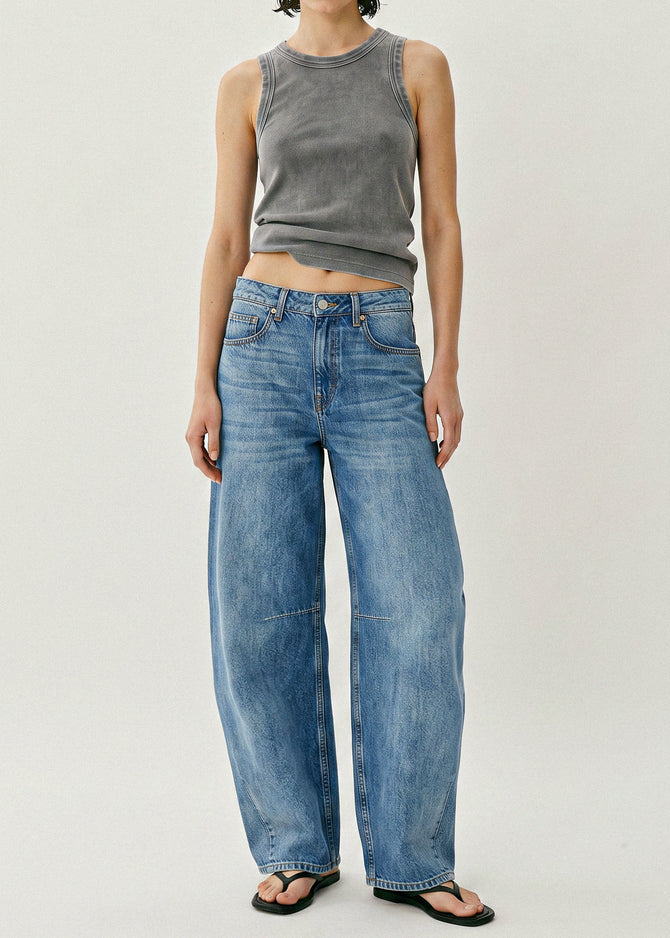
The Kallie Relaxed Curve in Baltimore is a useful example because it is made from 100% cotton and has a mid-dark blue wash with hand-sanding that extends toward the hem. Its high rise, loose hip, full-length curved leg, and knee and hem darts give the fabric a visibly structured shape. Those product details do not create a special universal wash schedule: inspect the jeans after wear and follow the care label inside the garment.
Common questions about washing jeans
Should you wash jeans after every wear?
Usually not after ordinary, low-sweat wear. Wash sooner if they are visibly dirty, stained, sweaty, or still smell after airing.
Can you refresh jeans without washing them?
Airing them in a dry, ventilated place can help after light wear, and a small fresh mark may be spot treated. Neither method replaces a wash when the garment is genuinely soiled or retains odor.
Does freezing jeans clean them?
No. Freezing is not a reliable substitute for removing body oils, dirt, stains, and other soil. Use actual laundering when the jeans need cleaning.
Is hand-washing always better?
Not always. Some garments benefit from hand-washing, while many jeans can be machine washed correctly. The care label should decide the method.
The practical answer
Use 3 to 10 ordinary wears as a flexible reference, then let real conditions shorten or lengthen the interval. Wash for a reason—not automatically after every wear, and not only after reaching an arbitrary number. Air between light wears, treat small stains promptly, and use a gentle labeled wash process when the jeans genuinely need cleaning.
If you are looking for a rigid-cotton pair whose wash and sculpted construction will develop with real wear, explore the Kallie Relaxed Curve in Baltimore; its care label remains the final guide for washing and drying.