

Two pairs of jeans can share a style name and size yet fit differently because the finished garments may not be identical. Washing, abrasion, softening and drying can change stiffness, drape and dimensions, while separate production runs may also use revised measurements or fabric. Compare each wash as its own product: check the current garment measurements, fiber content and return policy before choosing a size.
Why can the same jeans feel different in another wash?
A style name usually identifies the design family: its intended rise, leg shape, pocket arrangement and overall proportion. It does not always promise that every color or wash was cut from the same fabric lot, finished with the same recipe or produced to identical current measurements.
This distinction matters because shoppers often blame the wash for every difference. Finishing can absolutely change how denim feels and hangs, but a revised pattern, a different fabric specification or ordinary manufacturing tolerance can also be involved. The product page for the exact wash is therefore more useful than the name of the fit alone.
What can the wash process change?
Initial stiffness and drape
Dark rinse denim may receive relatively limited abrasion and can feel firmer or more board-like at first. A more washed-down finish may arrive softer and form folds more easily. CottonWorks explains that denim finishing can include desizing, softening, enzyme treatment and mechanical action; the chosen process and its duration affect the surface and hand of the garment.
That difference in hand can change the way a familiar cut reads on the body. A firmer jean may hold the curved outline away from the leg, while a softer version can collapse closer to the hips and knees even when the underlying pattern is similar.
Dimensional change
Wet processing and drying can influence garment dimensions. Manufacturers control and test this during development, but cotton can respond to moisture, heat and mechanical action. A heavily processed wash may therefore finish with a slightly different waistband, inseam or leg opening from a darker version.
That does not mean lighter jeans always run smaller or darker jeans always run larger. Wash color is not a reliable sizing rule. Only the measurements for the individual product can answer that question.
Surface abrasion and flexibility
Enzyme and stone-style treatments remove color and fiber from the surface to create highlights and a broken-in feel. More abrasion may make the garment feel easier immediately, while a clean dark rinse may need more wear before it feels equally relaxed. For a deeper explanation of one common finish, read What Is Stonewashed Denim?

Can a different wash change the actual size?
It can contribute to a small dimensional difference, but the wash may not be the only cause. If two versions list different rises, inseams or leg openings, treat those as two current garment specifications rather than assuming they are identical jeans in different colors.
The fiber label also matters. A 100% cotton version will not behave like a version containing elastane, even when both carry the same fit name. Fabric weight, weave and finishing can further change how much structure you feel. Color alone cannot tell you any of those details.
A real NOEND example: three Kallie washes
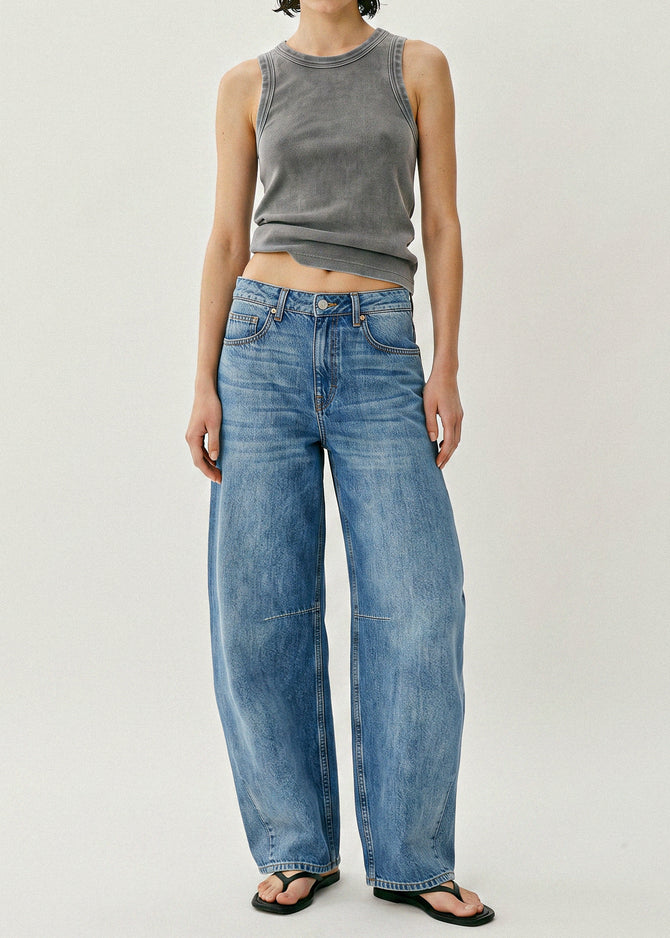
NOEND’s Kallie Relaxed Curve is useful for seeing why wash-specific information matters. All three versions below share a high-rise relaxed curve concept, a wide easy leg and shaping darts, but their current product pages are not identical.
Kallie in Holland
Kallie Relaxed Curve in Holland is a clean super-dark wash in 100% cotton. Its current page lists an approximate 13-inch front rise, 23.5-inch knee, 17-inch leg opening and 31-inch inseam.
Kallie in Baltimore
Kallie Relaxed Curve in Baltimore uses a mid-dark blue wash with hand-sanding extending toward the hem. It is also 100% cotton, and its current listed measurements match Holland: approximately a 13-inch front rise, 23.5-inch knee, 17-inch leg opening and 31-inch inseam.
Kallie in Madison
Kallie Relaxed Curve in Madison is another 100% cotton interpretation of the signature shape. Its current page lists an approximate 12.5-inch front rise, 24.5-inch knee, 19.5-inch leg opening and 30-inch inseam.
The useful conclusion is not that one wash is more accurate than another. It is that the wash-specific page should be the source of truth. Madison’s listed proportions differ from Holland and Baltimore, so a shopper should not attribute every fit change to color or softness alone.
How should you compare washes before buying?
Compare the same size on each product page
Check the rise, waist, hip, knee, inseam and leg opening whenever they are supplied. If the brand provides garment measurements, compare them with a pair you already own rather than relying only on your usual tagged size. The guide How to Read a Jeans Size Chart explains how to make that comparison.
Read the complete fiber content
Confirm whether every wash uses the same fabric composition. A rigid 100% cotton jean can soften and relax with wear but does not recover like stretch denim. Even a small elastic-fiber percentage changes the experience.
Separate feel from fit
A softer jean may feel roomier because it bends more easily, even when its waistband measures the same. A firmer jean can feel tighter during sitting because it resists folding. Assess the waistband and measurements separately from the hand of the fabric.
Use one wash as a reference, not a guarantee
If you already own the style, note the exact wash, size and current measurements. Use that pair as a starting point, then compare the new wash product page line by line. If an important measurement is missing, ask the brand before ordering.

Recommended NOEND denim to compare
To see the same relaxed curve idea interpreted through different finishes, compare Holland, Baltimore and Madison side by side. Choose by the wash-specific measurements and the amount of structure you want, not by color alone.
The practical answer
When two washes fit differently, first verify whether the fabric and listed measurements are actually the same. Then account for finishing: a darker or less abraded jean may feel firmer, while a more processed wash may feel softer and drape closer to the body. Recheck the size chart for every wash, and keep the return window in mind when ordering online.
Frequently asked questions
Should I buy the same size in every wash?
Not automatically. Start with the same size, but compare the wash-specific garment measurements and fiber content before ordering. If the measurements differ meaningfully from the pair you own, choose from the numbers rather than the style name.
Do lighter-wash jeans usually fit looser?
They may feel softer because they have received more processing, but lighter color does not guarantee a looser cut. A light wash can measure smaller, larger or the same as a dark wash.
Will dark-wash jeans loosen with wear?
Many cotton jeans relax at high-movement areas such as the waist, seat and knees. The amount depends on the weave, weight, fit, finishing and fiber content; it cannot be predicted from the dark color alone.
Is a fit difference a quality problem?
Not necessarily. Different washes can be intentionally developed with different specifications. The concern is whether the individual product matches its stated measurements, construction and care information.