“Made in USA” tells you where key garment and fabric manufacturing occurred, but it does not automatically mean U.S.-grown cotton, 100% cotton denim, better fit, heavier fabric, or greater durability....
For a pair of jeans, “Made in USA” is a country-of-origin statement about where the garment and its fabric were manufactured—not a promise that every raw fiber grew in the United States. Under U.S. textile-labeling guidance, an unqualified claim generally requires the jeans to be manufactured domestically from fabric manufactured domestically. If imported fabric or foreign processing is involved, the label should qualify that difference clearly.
The most useful place to begin is the sewn-in origin label—not a flag graphic or a product name.
What Does “Made in USA” Actually Tell You?
It tells you something specific about origin. It does not serve as a general rating for quality, comfort, sustainability, or fit.
The Federal Trade Commission says an unqualified U.S.-origin claim must be supported. For most products, that means the final assembly or processing—and all significant processing—takes place in the United States, with foreign content limited to a negligible amount. Clothing also falls under textile-specific labeling rules, which focus on where the finished garment and the fabric were manufactured.
For jeans, the fabric matters
FTC textile guidance explains that most clothing can carry an unqualified “Made in USA” label when the final garment is manufactured in the United States from fabric that was also manufactured in the United States. The raw fiber can originate elsewhere. In practical terms, a U.S.-made pair of jeans does not automatically mean that its cotton was grown in the United States.
The smallest components are treated differently
For textile-origin labeling, the FTC notes that components exempt from fiber-content disclosure—such as some buttons and zippers—do not have to be traced in the same way as the fabric. That is another reason the label should not be interpreted as a literal statement that every thread, rivet, zipper tooth, and cotton fiber came from the United States.
Why the Exact Wording on the Label Matters
A few extra words can completely change what an origin statement means. Read the full phrase rather than stopping at “USA.”
“Made in USA”
This is an unqualified claim. On a textile product, it communicates domestic garment manufacturing and domestic fabric manufacturing under the applicable textile rules.
“Made in USA of imported fabric”
This is a qualified claim. It tells you that the garment manufacturing happened in the United States, while the fabric came from another country. The qualification is not a footnote; it is part of the origin statement.
“Assembled in USA” or “Cut and sewn in USA”
These phrases describe particular work completed domestically and may coexist with imported materials. They are more limited than an unqualified “Made in USA” statement, so the rest of the wording matters.
“Designed in USA”
This identifies where the design work happened. It does not, by itself, tell you where the denim was woven, cut, sewn, washed, or finished.
Cutting and sewing are separate steps in a jean’s manufacturing chain; qualified wording can identify which stages occurred domestically.
What the Label Does Not Tell You
Country of origin is useful, but it is only one part of the product story. “Made in USA” does not automatically answer any of the following questions.
Are the jeans rigid or stretchy?
Check the fiber-content label. A pair made from 100% cotton will behave differently from denim containing Lycra or elastane, even if both pairs share the same country-of-origin statement. Our guide to rigid versus stretch denim explains that difference in more detail.
How heavy is the denim?
Origin and fabric weight are separate specifications. A domestically made jean can use lighter or heavier denim, and the weight will influence drape, break-in, and seasonal feel. See what denim weight means before using origin as a shortcut for fabric character.
Will the jeans fit better or last longer?
Those outcomes depend on pattern, measurements, construction, materials, care, and how the jeans are worn. A country-of-origin statement is not a fit guarantee, durability rating, or promise that one silhouette will suit everyone.
Is the product automatically sustainable?
Domestic manufacturing can shorten some supply-chain distances, but the label alone does not disclose water use, chemistry, energy source, waste, labor conditions, packaging, or total transportation. Those claims require their own evidence.
Three NOEND Examples—and Why Their Differences Matter
Several current NOEND styles are listed as Made in USA, but they are not interchangeable. Their fabric compositions, measurements, and silhouettes demonstrate why origin should be read alongside the rest of the product information.
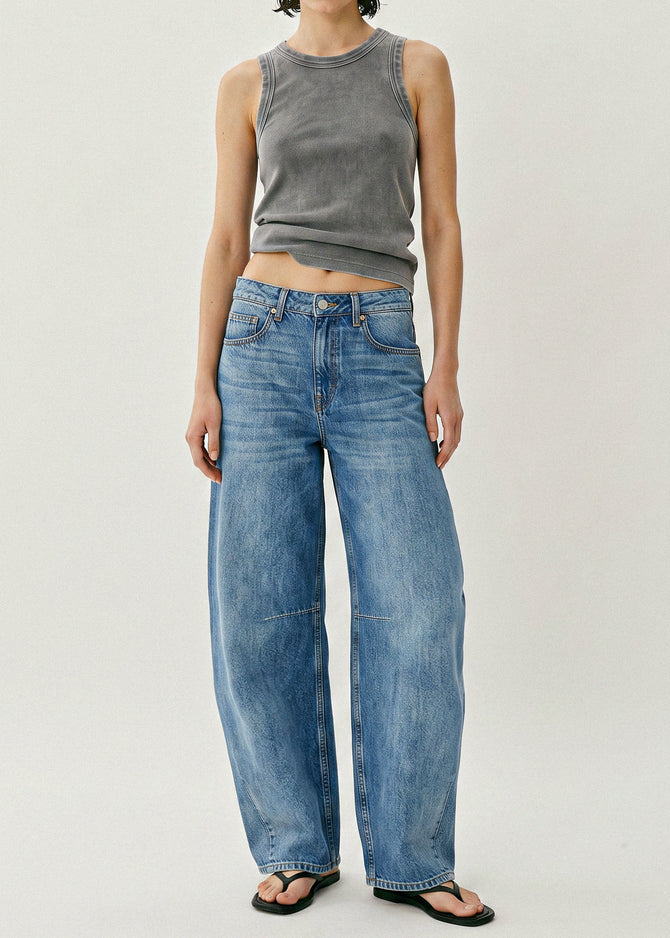
The Donna flare, Queen cropped wide leg, and Carter carpenter jean share a U.S.-origin claim while differing visibly in fabric and proportion.
Donna 90's Mid Rise Flare in Everwood
The Donna 90's Mid Rise Flare is listed as Made in USA and uses 99% cotton with 1% Lycra. It has an approximately 10-inch front rise, 33-inch inseam, 16.5-inch knee, and 21-inch leg opening. The long flare and stretch content create a very different wearing experience from a rigid carpenter jean.
Queen High Rise Crop Wide Leg in Black
The Queen High Rise Crop Wide Leg is also listed as Made in USA and is made from 99% cotton with 1% Lycra. Its approximately 12-inch rise, 29-inch inseam, 19-inch knee, and 21-inch leg opening create a high-rise, cropped wide-leg proportion.
Carter Carpenter Jeans in Pomona
The Carter Carpenter Jeans are listed as Made in USA and use 100% cotton. The approximately 12.5-inch rise, 27.5-inch inseam, 19.5-inch knee, 17-inch opening, reinforced knees, utility pockets, and hammer loop give the style a structured workwear direction.
The Most Useful Way to Think About the Claim
“Made in USA” is meaningful when you understand its scope. It tells you about the location of key manufacturing steps and, for covered clothing, the origin of the fabric used to make the garment. It does not replace the fiber label, measurements, construction details, or care instructions.
Start with the exact origin wording. Then ask the questions that determine whether the jeans suit your wardrobe: Is the denim rigid or stretch? What are the rise and inseam? How wide is the leg opening? Which construction details shape the silhouette?
If you would like to see how one origin statement can translate into three distinct jeans, compare the Donna flare, Queen cropped wide leg, and Carter carpenter jean by fabric and measurements—not by the origin line alone.
Frequently Asked Questions
Does “Made in USA” mean the cotton was grown in the USA?
Not necessarily. FTC textile guidance focuses on where the finished garment and its fabric were manufactured; raw fiber can originate elsewhere.
Can jeans made with imported denim still be made in the USA?
They can be manufactured in the United States, but the origin statement should disclose the imported fabric—for example, “Made in USA of imported fabric”—rather than using an unqualified claim.
Is “Designed in USA” the same as “Made in USA”?
No. “Designed in USA” addresses design work only. It does not state where the fabric was made or where the jeans were cut, sewn, washed, or finished.
Are Made in USA jeans always 100% cotton?
No. Country of origin and fiber content are separate disclosures. A Made in USA jean may be rigid 100% cotton or may include a small amount of stretch fiber.


 The most useful place to begin is the sewn-in origin label—not a flag graphic or a product name.
 The Donna flare, Queen cropped wide leg, and Carter carpenter jean share a U.S.-origin claim while differing visibly in fabric and proportion.