
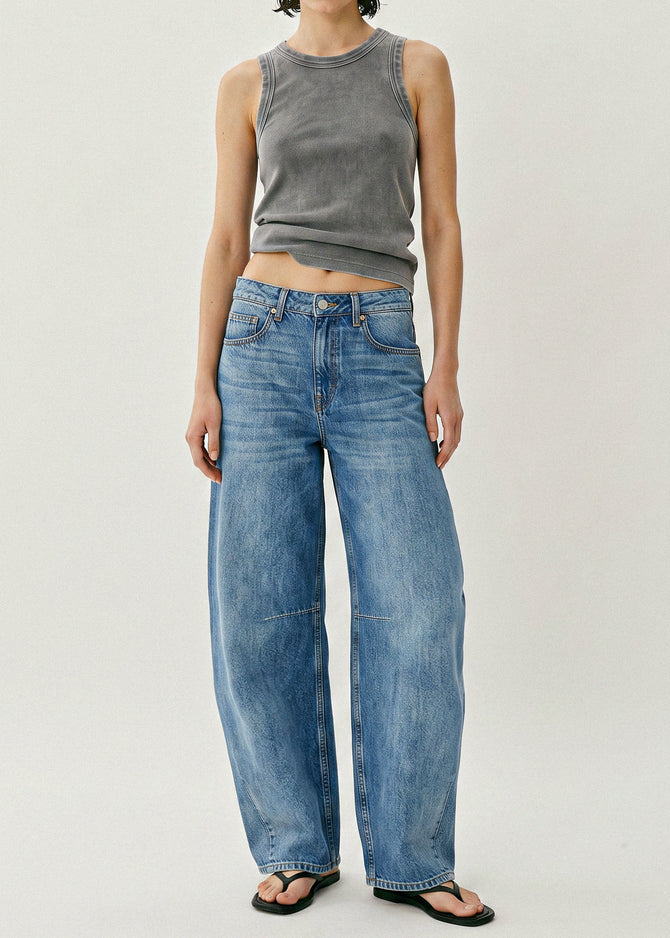


Denim weight belongs to the fabric specification: a controlled area of cloth is weighed before the number becomes part of the material description.
Denim weight describes how much one square yard of the fabric weighs, usually written in ounces such as 10 oz, 12 oz, or 14 oz. It matters because weight influences structure, drape, warmth, and how substantial the jeans feel at first. It does not determine quality by itself; yarn, weave, fiber content, finishing, and garment construction matter too.
What does “12 oz denim” actually mean?
In the U.S. denim trade, ounces per square yard is a common fabric-weight unit. A 12 oz denim means that one square yard of that fabric weighs 12 ounces. It does not mean that the finished pair of jeans weighs 12 ounces. A completed garment includes different sizes, pocketing, thread, hardware, labels, and varying amounts of fabric, so its total weight is a separate measurement.
Outside the U.S., fabric weight is often shown in grams per square meter, or gsm. One ounce per square yard is approximately 33.9 gsm, so 12 oz denim is about 407 gsm, while 13.75 oz denim is about 466 gsm. These conversions describe fabric mass per area; they still do not tell you the weight of the entire garment.
What counts as lightweight, midweight, or heavyweight denim?
There is no single universal boundary used by every mill or brand. Informally, shoppers may see denim below roughly 10 oz described as lightweight, fabric around 10–13 oz described as midweight, and fabric above roughly 13 oz described as heavyweight. Treat those labels as orientation rather than regulation.
For wider manufacturing context, CottonWorks describes finished denim fabrics spanning approximately 3.5 to 16.5 ounces per square yard. It notes that lighter 3.5–8 oz fabrics are commonly used for shirts and tops, while trousers, jeans, and jackets commonly use heavier 8–16.5 oz fabrics. That range explains why two garments can both be called denim yet behave very differently.
Why denim weight changes the way jeans feel
Structure and drape
Lighter denim generally follows the body and collapses into smaller folds more easily. A more substantial denim tends to hold a clearer line, create broader folds, and give a wide, straight, or baggy silhouette more visible architecture. Pattern shape and finishing can strengthen or soften this effect, so weight should be read alongside the cut.
Initial hand and break-in
A heavier rigid denim may feel firmer when new because there is more material and no stretch fiber to assist movement. That does not mean every heavy denim is harsh or every light denim is soft. Washing, resin or sizing, yarn type, weave density, surface finishing, and garment treatment all influence the initial hand. Break-in should improve movement and surface character, not rescue a waistband or seat that is fundamentally too small.
Warmth and seasonal use
More fabric mass often feels more insulating, which can make substantial denim appealing in cooler conditions and less appealing during high heat. But airflow also depends on how loose the jeans fit, how densely the cloth is woven, and what fibers are used. A roomy heavy jean may feel different from a tight one made from the same cloth.
Durability expectations
A higher ounce number means more fabric mass per area; it does not guarantee that the jeans will last longer. Abrasion points, yarn strength, weave, seam construction, fit, care, and how the garment is worn all matter. A heavy jean that constantly strains at the crotch can fail sooner than a lighter jean with a more appropriate fit.

What denim weight does not tell you
Weight is not the same as stretch
A 12 oz fabric may be rigid 100% cotton or a stretch blend. The ounce number reports mass per area, while fiber content and fabric engineering help determine elasticity and recovery. Read both specifications when comparing jeans.
Weight is not a quality grade
Heavier is not automatically better, more premium, or more authentic. A lightweight denim can be exactly right for fluid trousers, summer jeans, shirts, or soft layering pieces. Quality depends on whether the cloth, construction, finish, and pattern suit the intended garment.
Weight is not identical to thickness
Weight and thickness often move in the same direction, but they are not interchangeable measurements. Dense yarn packing, yarn size, weave, fiber blend, and finishing can produce fabrics with similar weights but different thickness, stiffness, and surface character.
Weight does not predict fit by itself
The same fabric weight can be cut into a slim, straight, curved, or baggy jean. Rise, seat, thigh, knee, opening, and inseam determine the silhouette. Use weight to understand the material, then use garment measurements and fit notes to understand the jeans.
How to choose a useful denim weight
Start with climate and routine
If you regularly walk, commute, or work in warm conditions, a lighter or moderate fabric may be easier to wear. For cooler weather or shorter periods outdoors, a more substantial denim may feel appropriate. There is no ideal ounce number independent of how and where you will use the jeans.
Match material to silhouette
Fluid wide-leg jeans and sharply structured baggy jeans can share a similar outline in a product photo yet move differently in person. If you want a pronounced architectural shape, look for enough fabric body to support it. If you want a softer line, prioritize drape and finishing rather than pursuing the highest weight.
Check movement, not only standing fit
Sit, bend the knee, walk, and check the waistband and crotch. A substantial rigid denim should allow normal movement in the correct size even if it feels firmer than stretch denim. Severe pulling, restricted sitting, or a fly under strain indicates a fit issue, not a break-in requirement.

A verified NOEND example: 13.75 oz rigid denim
The Men’s Baggy Rigid Jeans in Tombstone are made from explicitly listed 13.75 oz rigid denim—approximately 466 gsm. The product page also verifies 100% cotton, a black wash, heavy destroyed patching across the front and back, a relaxed baggy fit, and Made in USA construction.
Here, the weight supports the product’s substantial material story, while the pattern supplies the generous volume and subtle puddle at the shoe. The ounce number alone does not create that silhouette. Listed garment measurements—approximately a 14.25-inch rise, 30-inch inseam, 25.5-inch knee, and 22.5-inch leg opening—help explain how the fabric is being used.
Questions people ask about denim weight
Is 12 oz denim heavy?
It is commonly treated as a moderate or midweight denim, but category names vary. Compare it with the fabric’s fiber content, finishing, and intended garment rather than relying only on the label.
Does heavier denim stretch less?
Not necessarily. Weight and stretch describe different properties. A heavyweight denim can include stretch fiber, while a lighter denim can be completely rigid. Check composition and product-specific fit guidance.
Is heavyweight denim always warmer?
It often feels more insulating because there is more material per area, but weave density, fit, airflow, fiber content, and finishing also affect comfort.
Can you tell denim weight by touching it?
You can compare relative substance and drape, but touch cannot reliably produce an exact ounce value. For a precise number, use the mill or product specification.
The practical takeaway
Read denim weight as one material clue: it tells you fabric mass per area and helps anticipate structure, drape, warmth, and initial substance. Then check fiber content, stretch, finishing, silhouette, garment measurements, and your climate. The best weight is not the largest number—it is the cloth that makes sense for the way you want the jeans to look, move, and be worn.
For a concrete example of a disclosed substantial weight, explore the Men’s Baggy Rigid Jeans in Tombstone, where 13.75 oz rigid cotton denim is paired with an intentionally generous baggy cut.