
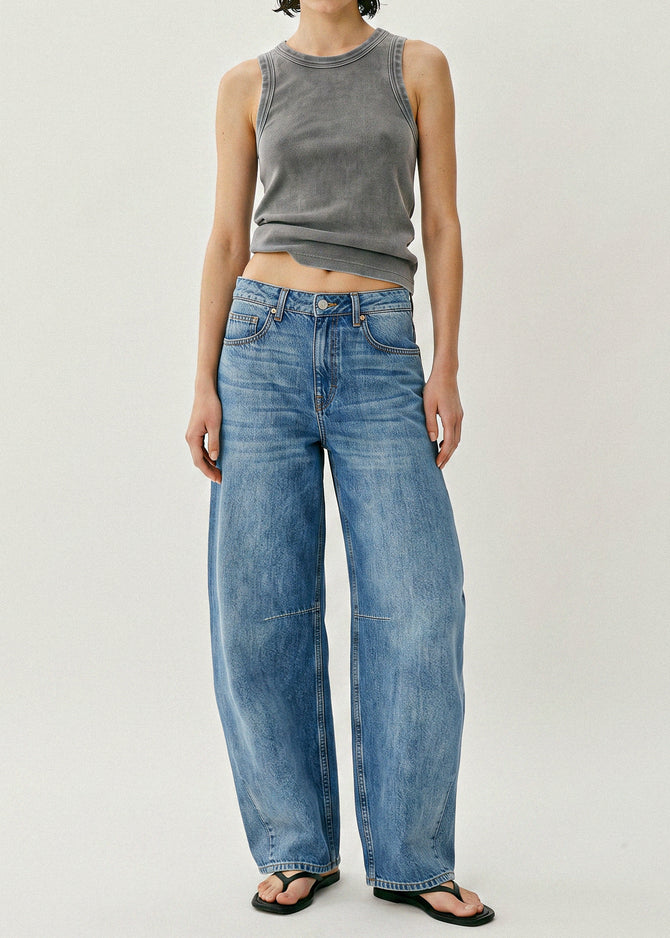


You can usually tell jeans are designed to pool at the hem when the extra length works with the cut rather than against it: the leg stays intentional from knee to opening, the fabric makes controlled folds over the shoe, and the back hem clears the floor. Product descriptions may also say full length, puddle, stacking, or drape over the instep. If the fabric disappears under your heel, it is probably just too long.
What intentional pooling actually looks like
A pooled hem is not simply a hem that touches a shoe. It is a length-and-shape decision: the lower leg has enough room and fabric to settle into soft folds while the jean still reads as one continuous silhouette.
The leg line stays coherent
Start above the hem. On jeans designed to puddle or stack, the line from the knee down usually remains relaxed and deliberate. A wide, curved, baggy or generous straight leg gives the extra fabric somewhere to go. The folds appear near the ankle and instep without pulling the knee out of place or twisting the side seam.
The shoe supports the fabric
Intentional pooling happens where the hem meets the upper of the shoe. You may see one deeper break or several softer folds, but the fabric should sit on the shoe—not vanish beneath it. A pointed toe creates a longer, cleaner drape; a low sneaker generally produces a fuller stack; a heel lifts more of the length away from the floor.
Look for clues in the product description
Before trying the jeans on, scan the product copy for words such as full length, puddle, stacked, long inseam, drape over the instep or folds over the foot. Those phrases are stronger evidence than a single styled image, especially when the model’s height and shoe height are not listed.
Also look at the measurements together. Inseam alone cannot tell you the full story. Rise, knee width, leg opening and the shape of the lower leg determine whether extra length will fall smoothly or bunch unpredictably.
A real design example
The NOEND Kallie Relaxed Curve in Holland is described as a full-length jean that is long enough to drape over the instep. Its wide leg, subtle inward curve and tapered hem are designed to create folds over the foot, so the extra length is part of the silhouette rather than a sizing accident.

How to separate a designed pool from jeans that are simply too long
The clearest test is movement. Stand naturally, walk across the room, turn, sit and step up once or twice. The shape should recover instead of collapsing around your feet.
Signs the length is intentional
- The folds form mainly over the instep or around the ankle.
- The side seams remain reasonably straight.
- The back hem stays above the floor while you stand and walk.
- The knee position still looks correct for your leg.
- You can take a normal stride without stepping on the fabric.
Signs the jeans may just be too long
- The fabric is repeatedly caught beneath the heel.
- Most of the excess collects only at the back of the shoe.
- The knee bags or drops because the whole leg is collapsing downward.
- The hem sweeps the ground, frays quickly or becomes wet outside.
- You need to hold the jeans up to use stairs safely.
If the cut looks right but the back hem still drags, a small alteration can preserve a soft front break without sacrificing wearability. Ask the tailor to pin the jeans while you are wearing the shoes you use most often.
Your shoes change how much the jeans pool
The same pair can look intentionally long with one shoe and awkward with another. That does not necessarily mean the jeans are incorrectly designed; it means hem behavior is a relationship between inseam, leg opening, fabric and footwear.

Boots
A structured ankle boot supports the hem higher on the foot, usually producing a cleaner break and less fabric near the ground. If boots are your main reference point, the companion guide How Long Should Jeans Be When You Wear Boots? explains where different cuts should land.
Low-profile sneakers
Because the upper sits closer to the floor, a sneaker allows more fabric to settle. This is where an intentional full length can create the most obvious puddle. Check the rear view carefully: a deeper front stack can still work, but the back hem should not disappear under the sole.
Heeled loafers or pumps
A heel lifts the hem and often changes a pool into a lighter fold. This can sharpen a wide or curved jean, but it may also reveal more shoe than the designer’s styling suggests. Judge the complete silhouette, not a fixed number of folds.
A quick fitting-room test
- Wear the shoes you are most likely to pair with the jeans.
- Let the waistband sit at its intended rise instead of pulling it higher to shorten the leg.
- Check the front: the hem should break or fold where it meets the shoe.
- Check the side: the seam should not corkscrew dramatically.
- Check the back: the hem should clear the ground and heel.
- Walk ten natural steps and confirm that you never step on the fabric.
For rigid denim, repeat the test after a few minutes of movement. The fabric may relax slightly, but a well-considered pooled silhouette should still keep its basic line.
The bottom line
Jeans are designed to pool when the extra length is supported by the cut, described as part of the intended fit and controlled by the shoe. The best evidence is a balanced combination of product language, lower-leg shape and real movement. A graceful fold over the instep is intentional; fabric trapped beneath the heel is a fit problem.
Two styles to see the idea in practice
For a softly structured women’s version, explore the Kallie Relaxed Curve in Holland. For a roomier unisex-leaning reference with a more obvious puddle at the shoe, see the Men’s Baggy Rigid Jeans in Hollywood. Both make the extra length part of the silhouette, though the curve, opening and degree of stacking are different.