
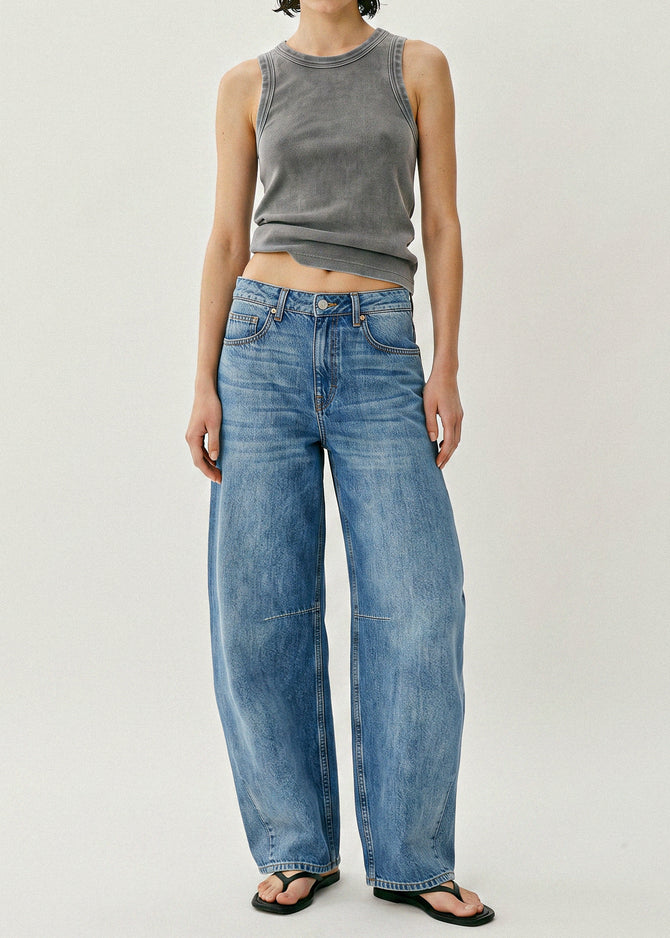


Some jeans can shrink, but shrinking is not a reliable way to make a loose pair fit exactly where you want. The result depends on the fabric and how it was processed, and more than one dimension may change. Before trying to make jeans smaller, identify where the fit feels loose, read the care label and consider whether a different size or alteration would address the problem.
Smaller does not always mean better fitting
Imagine a pair that fits well through the leg but feels loose at the waistband. You want a change in one place, while keeping the length and the room elsewhere. A laundry cycle cannot take instructions in that level of detail. Making the entire garment smaller is a different goal from refining one part of its fit.
CottonWorks explains that shrinkage depends on fabric construction and processing, including forces involved in dyeing and finishing. Dimensional changes can also affect how cloth and other garment components relate to one another. That is why fiber content alone cannot tell you an exact amount of shrinkage to expect.
The practical conclusion is to treat an unknown shrink response as an unknown, rather than a size-adjustment tool. A promise that one hot cycle will take every jean down exactly one size leaves out the details that determine the result.
Find out what kind of change you need
The whole pair was too loose from the start
If the jeans are new, check the retailer’s exchange conditions before washing or altering them. Compare the product’s fit description with what you expected. A relaxed or wide leg includes intentional room; if you want a narrower line throughout, a different cut may be a better match than trying to shrink that room away.
One area feels loose, but the rest works
Name the area as precisely as you can. Does the waistband slide, does the upper leg have more room than you prefer, or is extra length collecting near the shoes? These call for different conversations. Try sitting and walking as well as standing still, so a change you request does not remove room you use in motion.
The fit seems different after wearing
Compare the jeans at consistent stages. A pair just taken from storage and a pair worn through a long day are not the same observation. If cleaning is due, follow the ordinary care instructions and reassess once the garment is fully dry. Do not escalate the temperature just to see whether you can force a tighter result.

Shrink-to-fit is a specific instruction
Some products are deliberately sold around a shrinking process. For example, Levi’s distinguishes its Shrink-to-Fit jeans from its preshrunk styles and supplies particular sizing and care guidance. That is a product-specific system, not a method to transfer to every pair marked 100% cotton.
If a brand provides shrink-to-fit instructions for your exact style, use those instructions. Otherwise, ask what the manufacturer expects before making a plan around shrinkage. A dark color, a firm feel or the word “denim” is not enough information to classify a finished pair.
Consider a targeted adjustment instead
A tailor can assess a specific request and explain what the construction will allow. As an example of the distinction, Levi’s lists waist adjustments, leg tapers and hemming as separate alteration services. They address different parts of a garment; they are not interchangeable ways of making everything smaller.
Bring the jeans and the shoes you usually wear with them. Explain what currently works as well as what you want changed. Ask how a proposed alteration might affect pockets, seams and the original line. A consultation can establish whether the adjustment is worthwhile before anyone cuts or sews.
A belt may help you wear a slightly roomy waistband comfortably if you like the rest of the fit, but it does not alter the pattern. Likewise, a cuff changes how you wear excess length without changing the size. Treat those as styling choices, not proof that an ill-fitting pair has been corrected.
Keep laundry within its intended job
Use washing and drying to care for the jeans according to the label. Avoid boiling, concentrated heat or repeated high-temperature cycles as shortcuts to a smaller size. If normal care leaves the fit different from what you want, move to a sizing or alteration decision rather than repeating a treatment without a predictable endpoint.

Questions about making jeans smaller
Will 100% cotton jeans always shrink a full size?
No. Fiber content does not provide that prediction. Fabric construction, processing and the care method matter, and size labels are not a shrinkage measurement.
Can I shrink only the waistband?
Do not rely on a home heat treatment for a precise waistband adjustment. If the rest fits well, ask a tailor what can be changed while preserving it.
Does preshrunk mean shrink-proof?
Do not treat it as permission to ignore care instructions. Use the brand’s guidance for the specific garment instead of assuming any temperature will be suitable.
Should I buy jeans too large and shrink them later?
Only follow that approach when the exact product’s sizing instructions call for it. Otherwise, choose from its current fit guidance and measurements.
If room through the leg is part of the look you want, River High Rise Wide Straight in Helena offers a high-rise, wide-straight silhouette in 100% cotton. Choose that shape intentionally, with the right size, rather than planning to shrink it into a different cut.