
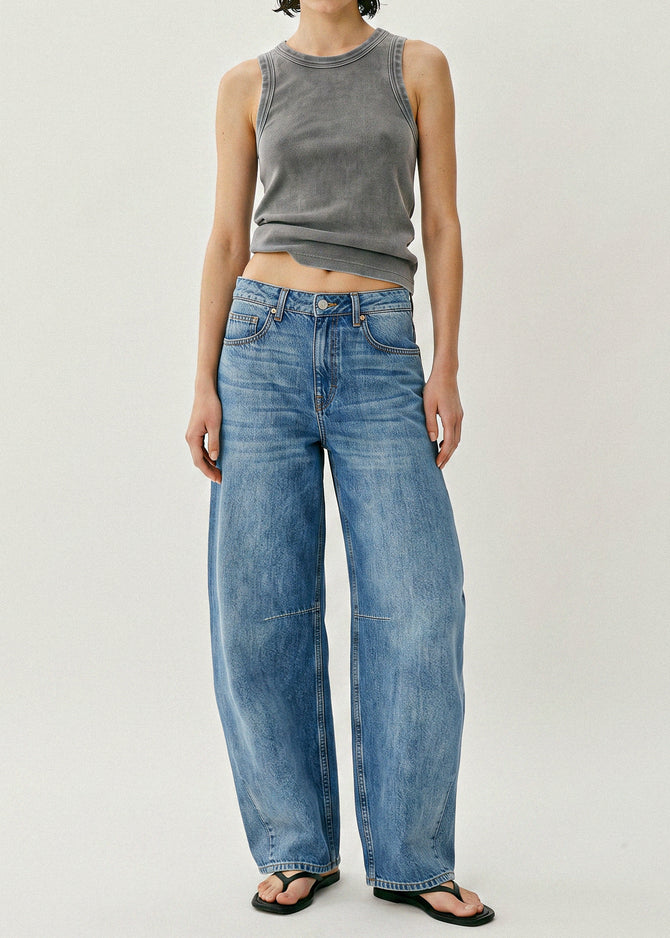


Some jeans can be dry cleaned, but the answer belongs to the finished garment’s care label, not to denim as a category. Read the instructions and any restrictions before booking the service. If the label is missing, unclear or only describes washing, ask the brand or a professional cleaner to assess the pair instead of assuming dry cleaning is automatically gentler.
“Dry” describes the cleaning method
Dry cleaning does involve liquid. The Drycleaning & Laundry Institute explains that dry-cleaning solvent does the main cleaning work. Professional wet cleaning uses water with specialized equipment and processes. Bringing jeans to a cleaner does not, by itself, tell you which of these services they will receive.
That distinction is useful when you want help with a difficult stain or simply prefer someone else to handle laundry. Ask what method is being proposed for this pair. “Professional care” is the beginning of the conversation, not the name of one universal treatment.
Read the whole instruction, including restrictions
Look for written directions as well as symbols. A note that limits a process is just as relevant as the main instruction. Photograph the complete label while it is readable so you have a reference if the print becomes difficult to see later.
The GINETEX symbol guide identifies the circle as the professional-care symbol. Letters such as P or F give cleaners information about permitted solvents; a bar underneath adds process restrictions. A crossed-out dry-cleaning circle means do not dry clean. A circled W refers to professional wet cleaning, which is not the same as choosing a wash cycle at home.
You do not need to select a solvent yourself. Show the complete instructions to the cleaner and ask them to explain the relevant route. If a symbol is faint, a guess based on its general outline is not a useful substitute for confirmation.
What if the label only says to wash?
The Drycleaning & Laundry Institute notes that a care label may list one suitable method without listing every possible option. That does not make an unlisted method an automatic yes or no. Follow the stated method, or seek advice before changing it. If a cleaner proposes an alternative, ask about the reason and any tradeoffs before agreeing.

Cotton content is useful information, not permission
A composition label tells you what the listed fabric is made from. It does not explain every finishing treatment or the requirements of every trim. Two pairs of blue cotton jeans can have different care instructions. Neither a familiar color nor a similar silhouette establishes that both should receive the same process.
The same applies to an expensive pair or a favorite vintage find. Price, age and sentimental value explain why you want careful handling; they do not identify the right cleaning method. Bring the actual garment for assessment instead of asking for a blanket rule for “premium denim.”
Make the drop-off conversation specific
Describe the reason for cleaning
Say whether this is ordinary cleaning or attention to a particular area. Point out the location and explain what happened if you know. Mention any product you have already applied and avoid guessing about a stain’s origin. A short, accurate history is more useful than naming a treatment you found online.
Show the details you want preserved
Point out deliberate fading, distressed sections, trims or an existing repair so there is a shared understanding of the starting condition. You can also explain how you usually wear the jeans: relaxed through the leg, for example, without a pressed center crease. Ask what finishing is included rather than assuming every service returns the same look.
Confirm the proposed method, expected result and any limits before leaving the pair. A cleaner may be able to assess an uncertain mark, but a promise to remove every mark or keep every finish completely unchanged is not a useful basis for deciding. If something remains unclear, leave the treatment undecided until you understand it.

Before you book the service
Can all 100% cotton jeans be dry cleaned?
No blanket rule follows from fiber content. Read the complete garment label and ask for clarification if the proposed service is not covered.
Does a dry-cleaning symbol mean home washing is forbidden?
Read the whole label, including the washing instructions. One symbol should not be used to invent instructions for a different process. Ask the brand or cleaner if the information is incomplete.
Will dry cleaning guarantee that dark denim keeps its color?
No such guarantee follows from the service name. Discuss the particular wash and finish with the cleaner before choosing a method.
What if the care label has been cut out?
Contact the brand with the style and wash information, or bring the pair to a professional for assessment. Do not borrow the instructions from a similar-looking jean.
If you are exploring an everyday blue straight leg, Miley Straight in Charleston pairs a loose silhouette with 100% cotton denim. Choose it for that fit and wash, then use the care instructions supplied with your own pair when deciding how to clean it.