
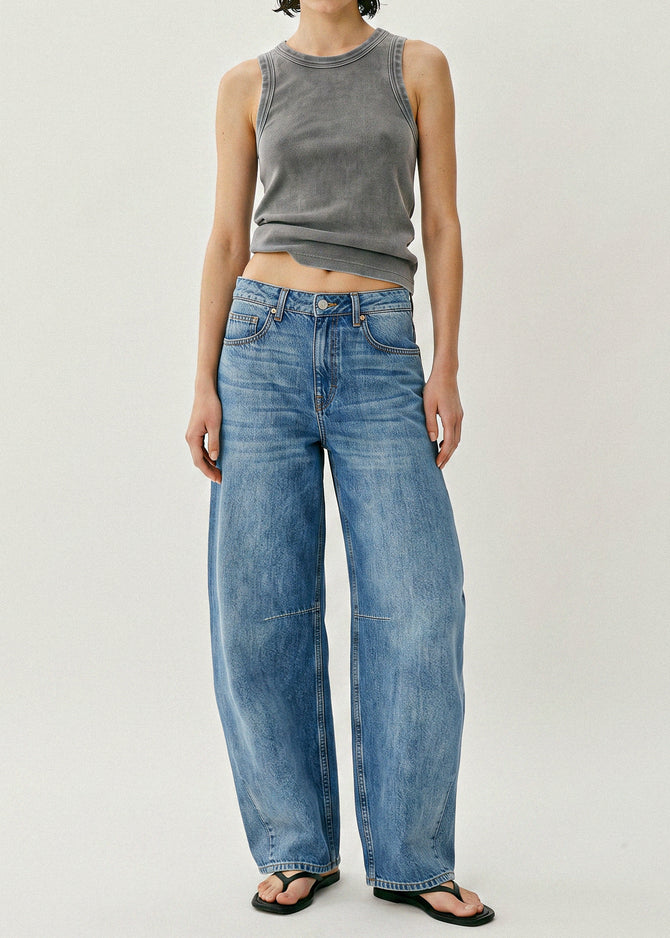


Slim straight jeans usually offer less room through the seat and thigh than a roomier straight cut, while keeping a relatively straight lower-leg line. “Straight” alone does not tell you how loose the whole pair will feel. Compare the rise, thigh, knee and leg opening together, then sit and walk in the jeans before deciding which version suits your preferences.
“Straight” describes only part of the fit
A straight-leg name is a starting point, not a full specification. Jeans can have a straight-looking lower leg and still fit closely through the top, or carry much more room from the seat downward. A slight change in width between knee and hem does not automatically make a retailer’s straight fit a different category.
Levi’s fit guidance lists both slim straight and relaxed straight styles within its range. The useful lesson is that the modifier matters: “slim” and “relaxed” add information that “straight” leaves open. Naming conventions vary, so compare the actual garments rather than assuming every brand uses identical boundaries.
Follow the fit from the seat to the hem
Seat and thigh
This is often where the practical difference becomes most noticeable. A slim straight may sit closer with less spare fabric when standing. A roomier straight can leave more space through the thigh. Neither description guarantees comfort; the rise and the way the garment fits your movements still matter.
Knee and lower leg
Look at how the line continues below the thigh. Does it remain close at the knee, or fall with more space around it? A lower leg can look straight without having exactly the same width at every point. Check whether the product description provides knee and opening measurements, and confirm how those measurements are taken.
Hem and length
A shorter slim straight can look particularly clean above a low shoe, while a longer, looser straight may show more folds at the bottom. Length can exaggerate the apparent difference between the cuts. When comparing two pairs, mentally separate the width of the leg from where the hem ends.

Use measurements without letting one number decide
If a pair you own fits well, use it as a reference. Compare like-for-like measurements: the same size where appropriate, the same measuring method, and the same point on the garment. A flat width and a full circumference cannot be compared directly.
Do not choose entirely by the hem opening. Two pairs with similar openings can feel different because one has more room above the knee. Equally, the same waist label does not mean the rise, seat and thigh will be identical. Read the fabric composition too, without assuming that stretch content automatically means a looser fit.
Keep your notes specific: “more space when sitting,” “closer below the knee,” or “hem stays clear of the shoe.” Those observations make the next comparison easier than a broad verdict that one pair is simply more flattering.
Make the fitting-room comparison fair
Try both pairs with the same shoes and a familiar top. Fasten each normally, let the waistband settle where the design is intended to sit, and avoid pulling one pair higher just to make its hem match the other. You are comparing the cuts as worn, not forcing them into the same outline.
Sit, take a few steps and bend your knees naturally. Notice persistent pulling, a waistband that repeatedly shifts, or a leg that feels more restrictive than you want. Some folds are normal when denim moves. The question is whether the fit supports your ordinary movements without constant adjustment.
Then look at the full outfit. A closer leg may give you the quieter outline you want beneath a roomy shirt. A looser straight may be your preference with the same shirt. These are styling choices, not rules that require a particular body type.

A closer line and a looser NOEND option
Eve High Rise Crop Slim Straight in Nashville is the closer, cropped option in this comparison. Miley Straight in Charleston is described as a loose fit and provides a roomier straight-leg alternative. Both current product descriptions list 100% cotton, so the comparison is useful for looking at cut rather than assuming the closer pair relies on stretch fibers.
They also differ in length and rise. Treat them as two distinct designs rather than expecting the same fit with a little width removed. Check each product’s current measurements and size guidance before choosing.
Questions about straight and slim straight jeans
Are slim straight jeans the same as skinny jeans?
No. Slim straight generally keeps a straighter lower-leg outline. A skinny fit is usually designed to follow the leg more closely toward the ankle.
Should I size up in slim straight jeans?
Not automatically. Start with the size information for that exact style. If the cut feels too close in one area, a roomier straight may be a better comparison than a larger waist.
Can straight jeans still be narrow?
Yes. “Straight” does not promise a loose thigh or a wide opening. Read the full fit description and look at multiple views.
Which fit is easier to style?
The one that works with the proportions and shoes you already enjoy. Try a familiar outfit with both before building an entirely new wardrobe around either cut.
For a direct starting point, compare Eve High Rise Crop Slim Straight in Nashville with Miley Straight in Charleston, paying attention to the whole leg rather than the fit name alone.