


Yes, if the care label allows it—but air-drying is gentler. When a dryer is necessary, turn jeans inside out, use low or no heat, and remove them while slightly damp to finish on a rack. Repeated high heat can accelerate fading, shrink cotton, distort fit, and weaken stretch fibers. Raw, dark, coated, embellished, or unfamiliar denim should usually stay out of the dryer unless its label says otherwise.
So, can jeans go in the dryer?
Some jeans can go in the dryer, but “can” and “best for the garment” are not always the same answer. The dryer combines heat, tumbling, and time. That makes drying convenient, yet those same forces can change denim’s color, dimensions, surface, and stretch recovery over repeated cycles.
If the sewn-in care label permits tumble drying, an occasional low-heat cycle is generally the cautious machine option. If it says line dry, hang dry, dry flat, or do not tumble dry, follow that direction. When the label is missing or unreadable, air-drying is the lower-risk default.
The shortest useful answer
- Safest for most jeans: air-dry in shade with good airflow.
- Fastest cautious option: tumble briefly on low or no heat, then remove while slightly damp.
- Most likely to change the jeans: repeated high heat or overdrying.
Why high heat can be hard on denim
Denim feels substantial, but durability does not make it immune to heat and abrasion. A hot, long cycle can encourage cotton shrinkage, especially when the garment has not been fully preshrunk. Tumbling also creates friction, which can make indigo lose color faster at raised areas, seams, pockets, and folds.
Stretch denim has an additional concern: its elastic fibers are included for flexibility and recovery, and repeated high heat can shorten their useful life. A rigid 100% cotton jean has no elastane to damage, but it can still shrink, fade, soften, or change shape. Our guide to how 100% cotton jeans relax with wear explains why a washed or dried pair may feel firmer again.
Overdrying matters as much as temperature
Leaving jeans tumbling after they are already dry adds unnecessary heat and mechanical wear. A sensor cycle, low-heat setting, or short timed interval can reduce that exposure, but dryer names vary by appliance. Read the temperature description rather than assuming a cycle called “Jeans” is automatically gentle.

How to put jeans in the dryer more safely
- Read the care label. Confirm that tumble drying is permitted and note the stated temperature.
- Turn the jeans inside out. This reduces direct friction on the visible face of the denim.
- Close the zipper or buttons. Fastening the fly helps the garment keep its shape and prevents hardware from catching.
- Use low or no heat. Avoid automatically choosing the hottest “heavy” or “jeans” cycle.
- Keep the load light. Jeans need room to tumble; an overpacked drum dries unevenly and takes longer.
- Check early. Remove the jeans while they are still slightly damp rather than waiting until they feel hot and bone-dry.
- Reshape and finish in air. Smooth the waistband, side seams, inseams, and hems, then hang or drape the jeans evenly on a rack.
Turning denim inside out is useful in both the washer and dryer, but it does not make high heat harmless. For the full reasoning, see Should You Wash Jeans Inside Out?
Which jeans should usually stay out of the dryer?
Raw or shrink-to-fit denim
Raw and shrink-to-fit denim can change considerably when exposed to water and heat. Unless the maker gives a specific shrink process, machine drying is a poor experiment: the waist, rise, inseam, and leg opening may not change evenly.
Dark or highly saturated denim
Dark jeans can show friction and color loss more readily. Air-drying inside out and away from direct sun helps reduce avoidable fading. If color preservation is your priority, pair this advice with our guide to preventing dark denim from fading.
Stretch denim
Jeans containing elastane, Lycra, or spandex should be kept away from repeated high heat. When the label permits machine drying, low or no heat is the conservative choice; air-drying better protects long-term recovery.
Coated, embellished, patched, or distressed jeans
Heat and tumbling may affect coatings, adhesives, decorative hardware, repairs, or intentionally frayed areas. Follow the specific label rather than treating these jeans like plain cotton denim.
Can a dryer fix stretched-out jeans?
A wash-and-dry cycle may make cotton jeans feel temporarily firmer, but using high heat as a sizing tool is unpredictable. The waistband, length, rise, and legs may not shrink by the same amount, and repeated attempts can fade or wear the fabric. If a pair is consistently too loose, tailoring or choosing a better size is more controlled than trying to cook it smaller.
Similarly, the dryer is not a reliable way to restore worn elastic fibers. Heat may make the garment feel different immediately after drying, but it cannot rebuild damaged stretch yarns.
Air-drying jeans without making them stiff
Air-dried denim may initially feel firmer because it has not been softened by tumbling. That does not mean it is damaged. Shake the jeans gently after washing, smooth the seams, and position them so air reaches both sides. Once dry, a few minutes of wear usually softens rigid cotton naturally.
Three practical drying routes
- Full air-dry: best when you have time and want to minimize heat and abrasion.
- Air-only tumble: useful when the label permits tumbling and you want more movement without heat.
- Low-heat start, air-dry finish: a practical compromise when time is limited.
Whichever route you choose, avoid hanging a very wet pair from one narrow belt loop. Support the waistband or drape the jeans across multiple rack bars so the weight is distributed.
How often should jeans be dried?
You only need to dry jeans after they have been washed or thoroughly wet. Washing less often—when hygiene, odor, and visible soil allow—also means fewer drying cycles and less cumulative friction. Our separate guide to how often to wash jeans helps distinguish a refresh from a full wash.
Spot cleaning a small mark and airing the jeans between wears can sometimes postpone a complete wash, but stains, spills, sweat, and odor should still be addressed promptly and appropriately.
What this means for NOEND rigid denim
NOEND’s current River High Rise Wide Straight in Reno, Kallie Relaxed Curve in Baltimore, and Kent Relaxed Straight in Michigan are each listed as 100% cotton rigid denim. Their different silhouettes do not create one shared dryer instruction, so always use the care label sewn into the individual garment as the final authority.
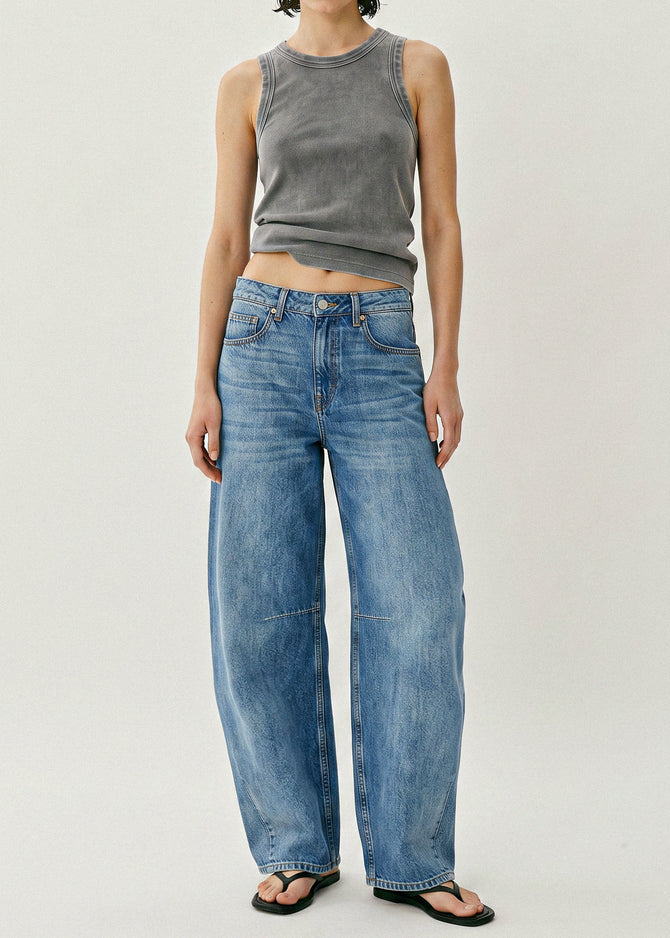
The River shown in this guide has a high rise, five-pocket construction, wide-straight leg, and slightly frayed hem. Supporting the full length while air-drying helps avoid placing all the wet weight on one point. The same principle applies to the fuller curved leg of Kallie and the relaxed straight shape of Kent.
Frequently asked questions
Will jeans shrink in the dryer?
They can, especially with heat. The amount depends on fiber content, whether the denim was preshrunk, garment finishing, moisture, temperature, and drying time. Do not assume every dimension will shrink evenly.
What dryer setting is safest for jeans?
If the care label permits tumble drying, low heat or no heat is the cautious choice. Remove the jeans while slightly damp and finish drying them in air. Appliance cycle names vary, so check the actual temperature.
Can you put wet jeans straight into the dryer?
Yes, when the care label allows it and the washer has completed its spin cycle. Do not put dripping, hand-wrung jeans into the dryer; remove excess water gently and avoid overloading the drum.
How long do jeans take to air-dry?
There is no fixed time. Fabric weight, room temperature, humidity, airflow, and how much water remains after spinning all matter. Give both sides airflow and wait until seams, pockets, and the waistband are fully dry before storing.
Can I use high heat once if I am in a hurry?
One cycle may not visibly ruin every pair, but it increases the chance of shrinkage, fading, and fiber stress. A short low-heat cycle followed by air-drying is the more controlled shortcut when the label permits machine drying.
The bottom line
You can put some jeans in the dryer, but the care label decides—not the fact that the garment is denim. Air-drying is the gentlest default. When machine drying is allowed, turn the jeans inside out, fasten the fly, choose low or no heat, check early, and finish in air rather than overdrying.
If you are choosing a rigid jean whose shape is designed into the cut from the start, explore the wide-straight River, curved-leg Kallie, or relaxed-straight Kent—then let the label guide how that specific pair should be dried.